
Quick summary
- Best for
- Piazza Navona visitors, short central walks, and art-plus-square planning
- Time needed
- 30-60 minutes
- Core churches
- 2
- Walking distance
- A very short square-side loop best done on foot
Before you start
Route summary
Choose this guide when you want the clearest church answer for Piazza Navona itself. Start with San Luigi, continue to Sant'Agnese, then decide honestly whether the day should turn east toward the Pantheon, west toward Campo de' Fiori, or stop here.
Why choose this route
Piazza Navona often sits in the middle of a Rome day without properly owning any of it. Visitors arrive because of the square, drift past one or two churches, then continue east or west without ever making a clear decision about what this part of the center is actually for. This route fixes that by treating Navona as its own stop in the day rather than as a blurred transition between the Pantheon and Campo. San Luigi dei Francesi gives the route its fastest serious art payoff. Sant'Agnese in Agone gives the square its religious and architectural meaning. Together they are enough to justify the route because each one explains a different side of the area: one chapel-focused and inward, one urban and square-facing. That contrast is the reason to choose this guide. The route does not need a third official stop just to feel complete. Its strength is that it stays square-led, then hands off cleanly once the visitor has decided what to do next.
How to use this guide
Treat this as the route you choose when Piazza Navona itself is the priority. Start at San Luigi if painting matters most, or begin on the square if the piazza is already your anchor, but keep the walk inside the Navona orbit until the two-stop core is done.
- If you have about 30-45 minutes, do San Luigi and Sant'Agnese properly and stop there.
- If you have closer to an hour, use the extra time for slower looking, not for automatic route expansion.
- If the day still has room after Sant'Agnese, use the next-step guidance below instead of pretending the next church belongs to the same official loop.
Best 30-60 minute version
San Luigi dei Francesi -> Sant'Agnese in Agone This order works because it begins with the most focused interior payoff, then moves into the church that explains the square itself. The walk is short, natural, and easy to follow on foot, with no need to backtrack or overdesign the route. It leaves you in the right place to stop cleanly or choose one next direction with intent.
- Short version: move through both churches in about 30 minutes if the day is crowded or compressed.
- Better version: let San Luigi stay focused, then give Sant'Agnese enough time to make Piazza Navona feel earned rather than incidental.
- Do not add a third official stop just because other churches are nearby. This guide is supposed to stay honest about what Navona itself can support.
How long to spend
Use these timings to keep the route compact without reducing it to a box-ticking pass through the square.
- San Luigi dei Francesi: 10-20 minutes
- Sant'Agnese in Agone: 15-25 minutes
- Quick version: about 30-40 minutes
- More rewarding version: about 45-60 minutes
What to do next
The core route ends after Sant'Agnese. From there, choose one next direction only if the day still has space.
- Continue toward Santa Maria sopra Minerva only if you want more depth after the square. Treat that as a handoff to the Pantheon guide, not as a hidden third Navona stop.
- Continue toward Sant'Andrea della Valle only if the walk is already turning west toward Campo de' Fiori and Corso Vittorio.
- Stop here if the square has done its job. A two-stop route that solves Navona properly is more useful than a longer route that never decides what it is.
Stops in this guide
Stop 1
Art-first core stop
San Luigi dei Francesi
A compact but essential church near Piazza Navona, especially for visitors who want one short central stop with very high artistic return.
Start here when you want the route to begin with immediate artistic value rather than square atmosphere alone. The reason to come is precise: the Contarelli Chapel and Caravaggio's Saint Matthew cycle. This is the stop that proves the Navona side can deliver a serious church visit even if you only have a short window in the center. What makes San Luigi right for this route is its concentration. It gives you one of the strongest painting payoffs in Rome without forcing a long detour or a large time commitment. In Navona terms, it sets a high standard immediately.
Stop 2
Square core anchor
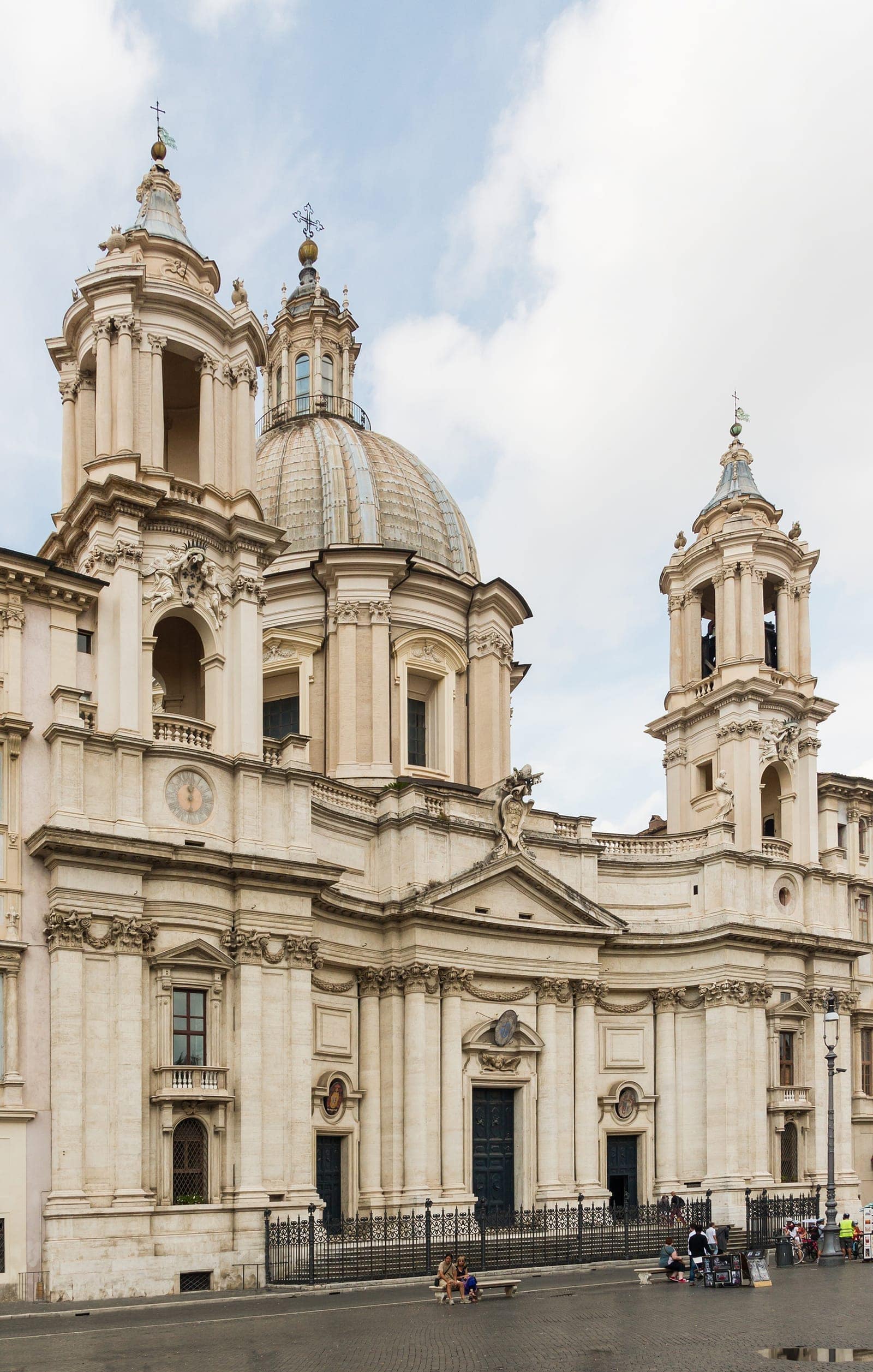
Sant'Agnese in Agone
The church that gives Piazza Navona a real ecclesiastical anchor, useful for visitors who want the square to feel like more than a scenic pause.
Continue here when you want Piazza Navona itself to become more than scenery. Sant'Agnese gives the square a church that actually belongs to it, not just one that happens to be nearby. After the chapel-focused experience at San Luigi, this is the stop where the route opens outward and explains why the piazza deserves a religious and architectural reading as well as a photographic one. This is the stop that makes the guide square-led instead of art-led alone. Visitors often remember the square first and the church second; a good route reverses that just enough that Navona starts to feel owned rather than passed through.
Choose a related route
Use one of these if you want a tighter route or a clearer next step.