
Quick summary
- Best for
- Westward central walks, larger Baroque interiors, and Chiesa Nuova-side planning
- Time needed
- 60-90 minutes for the core route; longer only with the river finish
- Core churches
- 3
- Optional additions
- 2
- Walking distance
- A practical westward line from central-west Rome toward Chiesa Nuova
This map follows the core route only. Keep the written guide for optional extensions and stop-by-stop judgment.
Before you start
Route summary
Choose this guide when the day is already moving west through Largo Argentina, Corso Vittorio, or Campo de' Fiori. Start with Il Gesù, continue to Sant'Andrea della Valle, finish at Santa Maria in Vallicella, then decide whether the route should end there or continue to San Giovanni dei Fiorentini.
Why choose this route
Many central Rome walks become too east-heavy. Visitors start near the Pantheon or Navona, keep adding churches, and end up with a route that never quite decides whether it belongs to the square, the art cluster, or the west-center side. This guide works because it begins later in that story. It assumes the day has already turned west and builds a route that actually fits that direction. Il Gesù gives the route its strongest first statement. Sant'Andrea della Valle gives the middle of the walk the scale it needs. Santa Maria in Vallicella gives the route a finish that still feels substantial even if you stop before the river. Together they make a clearer westward answer than any route that keeps reaching back toward the Pantheon for validation. That is why this guide works best when it stays focused on the westward route. Eastern central churches can point toward it, but they should not replace its main three-stop line.
How to use this guide
Treat this as the route you choose once the day is already on the Campo, Corso Vittorio, or Largo Argentina side. The strongest version starts with Il Gesù, moves into Sant'Andrea della Valle, then settles at Santa Maria in Vallicella before you decide whether to continue.
- If you have about an hour, stay with the three-stop core and let the route end at Chiesa Nuova.
- If you have closer to 90 minutes, add San Giovanni dei Fiorentini only if the river finish genuinely improves the day's direction.
- If you begin near Largo Argentina and want more scale before Corso Vittorio, add San Carlo ai Catinari as a starter; otherwise, leave it out.
Best 60-90 minute version
Il Gesù -> Sant'Andrea della Valle -> Santa Maria in Vallicella This order works because it starts with the strongest west-center anchor, builds through the broadest middle interior, then finishes at Chiesa Nuova without unnecessary backtracking. The walk keeps moving in one believable direction, and it stays distinct from the eastern central routes because it does not need Pantheon-side starters to justify itself.
- Short version: move through the three churches steadily and keep the route close to an hour.
- Better version: let Il Gesù and Sant'Andrea carry more of the time, then use Vallicella as the place to decide whether the day should stop or continue.
- Do not add eastern central churches to the official core. The strength of this guide is that it knows where the westward route truly begins.
How long to spend
Use these timings to keep the route coherent without stretching it into a central super-walk.
- Il Gesù: 15-25 minutes
- Sant'Andrea della Valle: 15-25 minutes
- Santa Maria in Vallicella: 15-25 minutes
- Optional additions: San Carlo ai Catinari 10-15 minutes if starting near Largo Argentina; San Giovanni dei Fiorentini 10-20 minutes if continuing to the river.
- Core route: about 60-75 minutes
- Longer version with one addition: about 75-90 minutes
Optional route layers
The official route is three stops. The two additions below are optional because they solve different route-entry and route-exit questions.
- Optional Largo Argentina starter: San Carlo ai Catinari. Use this only when the day begins near Largo Argentina and you want more scale before the route settles into Corso Vittorio.
- Optional river finish: San Giovanni dei Fiorentini. Use this only when the walk still wants Via Giulia, the river, or a Vatican-side continuation.
What to do next
After Santa Maria in Vallicella, decide whether the walk should end there or continue in one clear direction.
- Stop at Chiesa Nuova if the three-stop core has already done the job. The route still feels complete there.
- Continue to San Giovanni dei Fiorentini only if the day genuinely wants Via Giulia, the river, or a Vatican-side continuation.
- Look back to Piazza Navona or the Pantheon guides only if you are comparing central route families for another day, not because this route needs more core stops.
Core route and optional additions
Stop 1
West-center anchor
Il Gesù
One of the clearest central churches for understanding Roman Baroque theatricality, Jesuit ambition, and why some interiors in Rome feel built to overwhelm rather than simply decorate.
Start here when you want the route to announce itself immediately. Il Gesù is not a background church and does not behave like an optional extra. It is the interior that tells you the walk has left the tighter central clusters and entered a more forceful west-center line. This stop earns its place because it gives the route scale, Jesuit identity, and a stronger opening statement than a smaller connector church could manage. If Campo is going to own a central route, this is the church that proves it.
Stop 2
Corso Vittorio core
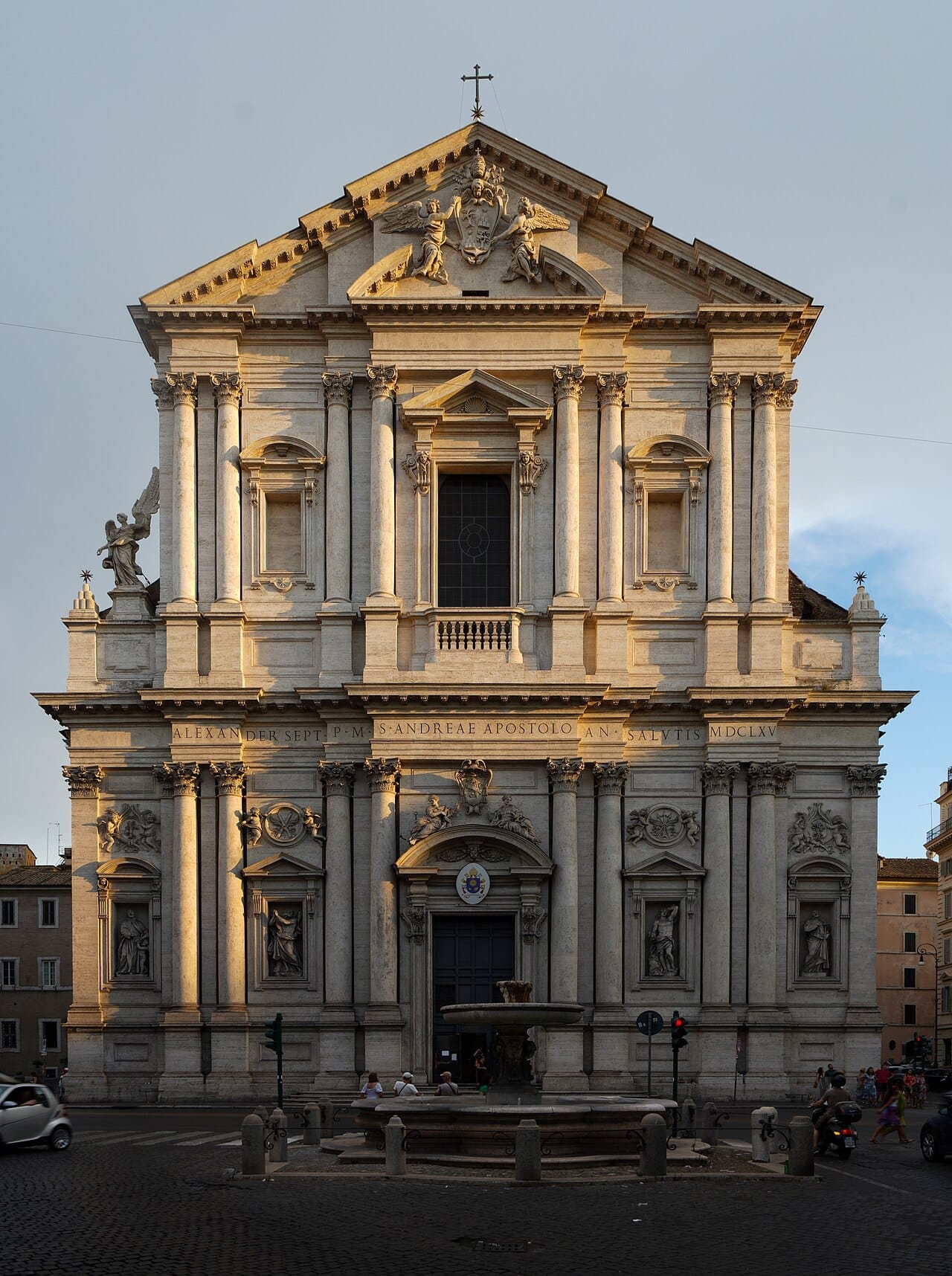
Sant'Andrea della Valle
A large Baroque church on the Campo de' Fiori and Corso Vittorio axis that gives this part of Rome one of its strongest interior set pieces.
Continue here when you want the route's middle section to feel substantial rather than transitional. Sant'Andrea della Valle is the stop that keeps the walk from flattening into a straight Corso Vittorio transfer. After Il Gesù, it gives the route another full-scale interior and confirms that this part of Rome can support a serious Baroque sequence of its own. It belongs in the official route because it deepens the westward movement instead of redirecting it. This is where the route feels most architectural and least incidental.
Stop 3
Chiesa Nuova finish
Santa Maria in Vallicella
A larger Baroque church that gives the Campo de' Fiori and Chiesa Nuova side of Rome one of its best interior anchors.
Finish here when you want a true Chiesa Nuova-side conclusion rather than a fading end to the walk. Santa Maria in Vallicella gives the route its most natural stopping point: large enough to matter, local enough to feel tied to this side of the center, and close enough to the next decision that the route can still pivot toward the river if needed. This is the stop that makes the core complete. If you stop here, the route still feels finished. If you continue after this, it is because the day genuinely wants the river, not because the core was incomplete.
Stop 4
River extension
San Giovanni dei Fiorentini
A substantial riverside basilica at the Via Giulia end of Rome, best for turning the Vatican-to-center walk into a real church route rather than a bridge transfer.
Use this only when the walk still wants Via Giulia, the river, or a Vatican-side continuation. It is a valid extension, but the route does not need it in order to feel complete.
Stop 5
Conditional Largo Argentina starter
San Carlo ai Catinari
A large Baroque church near Largo Argentina that gives central-west Rome a more substantial interior than many visitors expect from this part of the walk.
Use this only when the day begins near Largo Argentina and you want more scale before the route settles into Corso Vittorio. It works as a conditional first move because it strengthens the western start without dragging in the Pantheon family.
Choose a related route
Use one of these if you want a tighter route or a clearer next step.