
Quick summary
- Best for
- First-time visitors, short central routes, high-density walking
- Time needed
- 45–90 minutes
- Core churches
- 3
- Walking distance
- A compact central walk within a few minutes of the Pantheon
Before you start
Best for first-time visitors, short central walks, and anyone who wants a real church route near the Pantheon without turning it into a sprawling historic-center sweep.
Route summary
Choose this guide when you want one Pantheon-side church cluster that still feels worthwhile on a crowded day. Start with Minerva, continue to San Luigi, finish at Sant'Ignazio, then decide whether the next move is Piazza Navona, Campo de' Fiori, or simply the end of the route.
Why choose this route
The Pantheon zone can easily become one of those parts of Rome where you see a famous square, pass several churches, and remember none of them properly. This route avoids that by choosing three churches that do clearly different jobs within the same small central cluster.
- Santa Maria sopra Minerva gives the route its weight and substance.
- San Luigi dei Francesi gives it the quickest serious painting payoff.
- Sant'Ignazio di Loyola gives it the visual memory that changes the mood of the walk.
How to use this guide
Treat this as a central route you can complete before lunch, after lunch, or inside a larger historic-center day without losing energy. The most effective version starts near the Pantheon, gives proper time to Minerva, takes the focused art pause at San Luigi, then ends with the illusion and atmosphere of Sant'Ignazio.
- If you have about 45 minutes, keep moving and stay with the official three.
- If you have about 60–90 minutes, slow down at Minerva and San Luigi rather than adding more churches automatically.
- If you still want more after Sant'Ignazio, use the next-step guidance below instead of treating every nearby church as part of the same official route.
Best 45–90 minute version
Pantheon → Santa Maria sopra Minerva → San Luigi dei Francesi → Sant'Ignazio di Loyola. This order works because it begins with the route's deepest stop, narrows into the quickest Caravaggio pause, then ends with a theatrical visual payoff. The walk stays within a few minutes of the Pantheon throughout, avoids unnecessary doubling back, and leaves you with clean onward choices once the core is done.
- Short version: move through the three churches briskly and keep the route under an hour.
- Better version: allow Minerva to take the most time, let San Luigi stay focused, and use Sant'Ignazio as the final visual release.
- Do not add more official stops just because they are nearby. The strength of this route is its restraint.
How long to spend
Use these timings to keep the route strong without turning it into a rushed checklist or a drifting central marathon.
- Santa Maria sopra Minerva: 20–40 minutes.
- San Luigi dei Francesi: 10–20 minutes.
- Sant'Ignazio di Loyola: 10–15 minutes.
- Quick version: about 45 minutes total.
- More rewarding version: about 60–90 minutes.
What to do next
The core route ends after Sant'Ignazio. From there, choose one next direction only if the day still has space.
- Continue toward Sant'Agnese in Agone only if Piazza Navona is the next real destination. Let the Navona guide own that next stage properly.
- Continue toward Il Gesù only if the walk is already bending west and you want the broader Baroque line toward Campo de' Fiori.
- Stop here if the route has done its job. A short central walk that ends decisively is often more useful than one that keeps absorbing churches.
Stops in this guide
Stop 1
Pantheon anchor
Santa Maria sopra Minerva
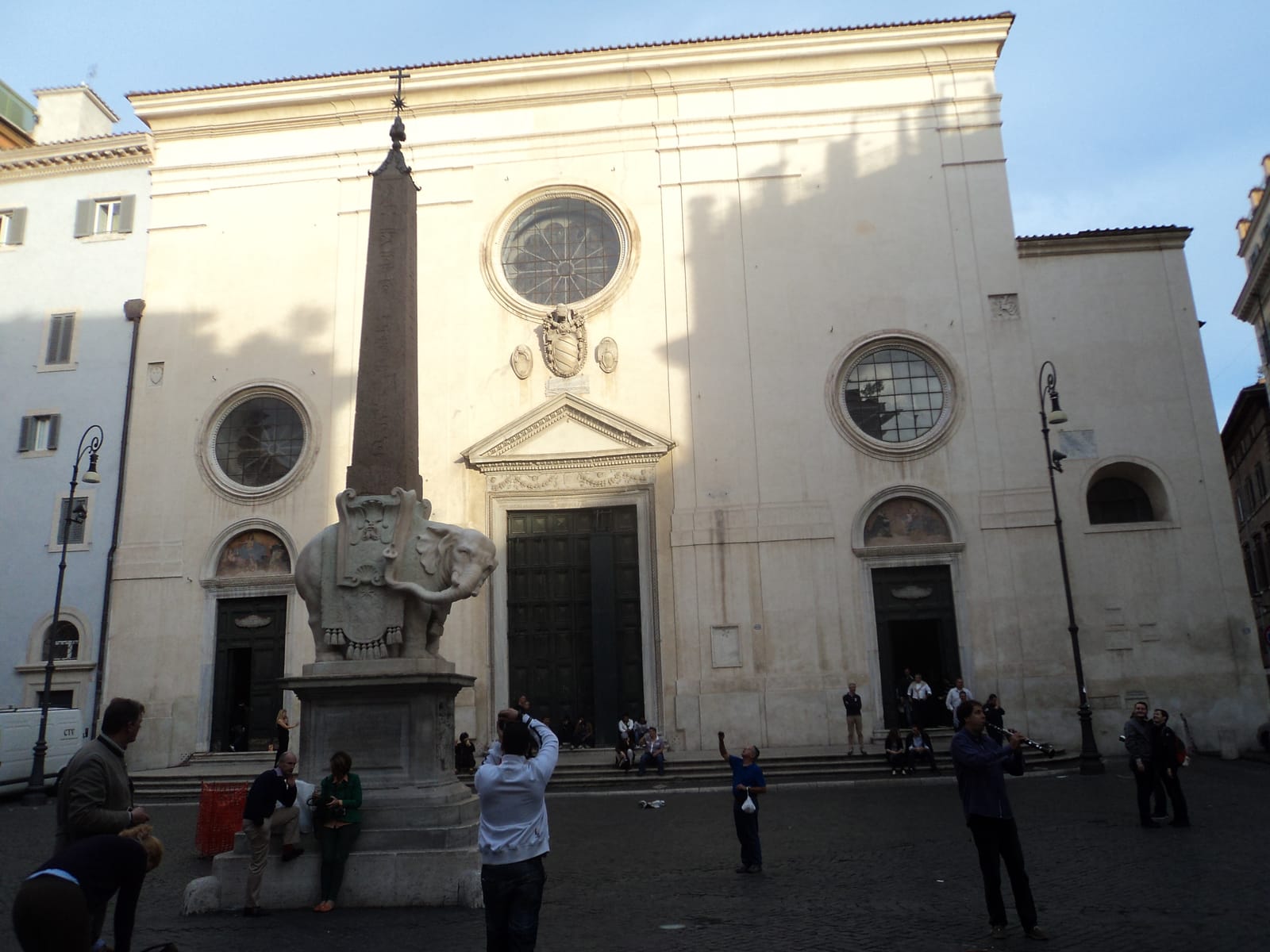
The strongest Pantheon-side church for visitors who want substance as well as convenience: Gothic bones, Dominican history, Michelangelo's Risen Christ, Filippino Lippi's Carafa Chapel, major tombs, and Bernini's elephant outside.
Start here if you want the Pantheon area to feel substantial rather than incidental. Minerva is the church that gives this route its seriousness: a rare Gothic interior in Rome, Michelangelo's Christ the Redeemer, the Carafa Chapel, Dominican identity, and major tombs all in one stop. Many visitors remember the elephant outside first, then realise inside that this is the church in the cluster that most deserves real time. Use it as the anchor, not the afterthought.
Stop 2
Focused art stop
San Luigi dei Francesi
A compact but essential church near Piazza Navona, especially for visitors who want one short central stop with very high artistic return.
Continue here when you want the fastest high-value art stop in the area. The reason to come is clear: the Contarelli Chapel and Caravaggio's Saint Matthew cycle. This is the stop that turns a short central walk into something more memorable than a square-to-square stroll. What makes San Luigi work in this route is its efficiency: a huge artistic return without the route losing momentum.
Stop 3
Theatrical finish
Sant'Ignazio di Loyola
A vivid central Baroque church whose illusionistic interior makes it one of the most memorable short art-and-architecture stops near the Pantheon side of Rome.
Finish here when you want the route to end with surprise rather than weight. Sant'Ignazio changes the mood immediately: after Minerva's gravity and San Luigi's focused chapel experience, this is the stop where painted architecture and illusion open the space upward. Visitors who are not expecting much often walk in, look up, and suddenly understand why this church earns a place even in a short route.
Choose a related route
Use one of these if you want a tighter route or a clearer next step.