Quick summary

Best for
Architecture-focused visitors, Borromini routes
Most visits take
Often a compact 15-25 minute architecture stop, with extra time if the courtyard and lantern are accessible.
Best area base
Centro Storico
Do not miss
Borromini design

Quick facts

Build the day from here

Best for

  • Architecture-focused visitors
  • Borromini routes
  • Repeat visitors to the historic center

Visitor notes

  • Best for architecture-focused travelers rather than visitors looking only for a large decorative interior.
  • Pairs naturally with Sant'Andrea al Quirinale and San Carlo alle Quattro Fontane in a Baroque-architecture day.
  • A short visit can be extremely rewarding if you already know to look for the geometry and lantern.

Short history

The church belongs to the Sapienza complex and reflects the intellectual and institutional side of Rome as much as its devotional one. That setting helps explain why the building feels so designed, so controlled, and so rewarding to visitors who like architecture that unfolds through geometry rather than scale alone.

Why visit

Visit for Borromini's design, for the famous lantern profile, and for a church stop that adds real architectural precision to a central route. The visit is strongest when you slow down enough to compare its interior, artworks, or atmosphere with nearby churches, then decide whether it deserves a quick pause or a longer place in the route.

  • Choose it if you are already planning around the historic center.
  • Use it when borromini design matters more than adding another famous name.
  • Pair it with Churches near the Pantheon: best short walking route for a more coherent route.

Why it stands out

Sant'Ivo alla Sapienza stands out because borromini design gives the visit a clearer purpose than a generic church stop, especially when compared with nearby interiors on the same walking route.

What to notice

  • This is one of the best central churches for visitors who care about architecture as much as devotional atmosphere.
  • It works particularly well as a Borromini stop on a Piazza Navona and Pantheon-side route.
  • The church helps the historic center coverage feel more intellectually varied, not just art-famous.

Notable features

  • Borromini courtyard sequence
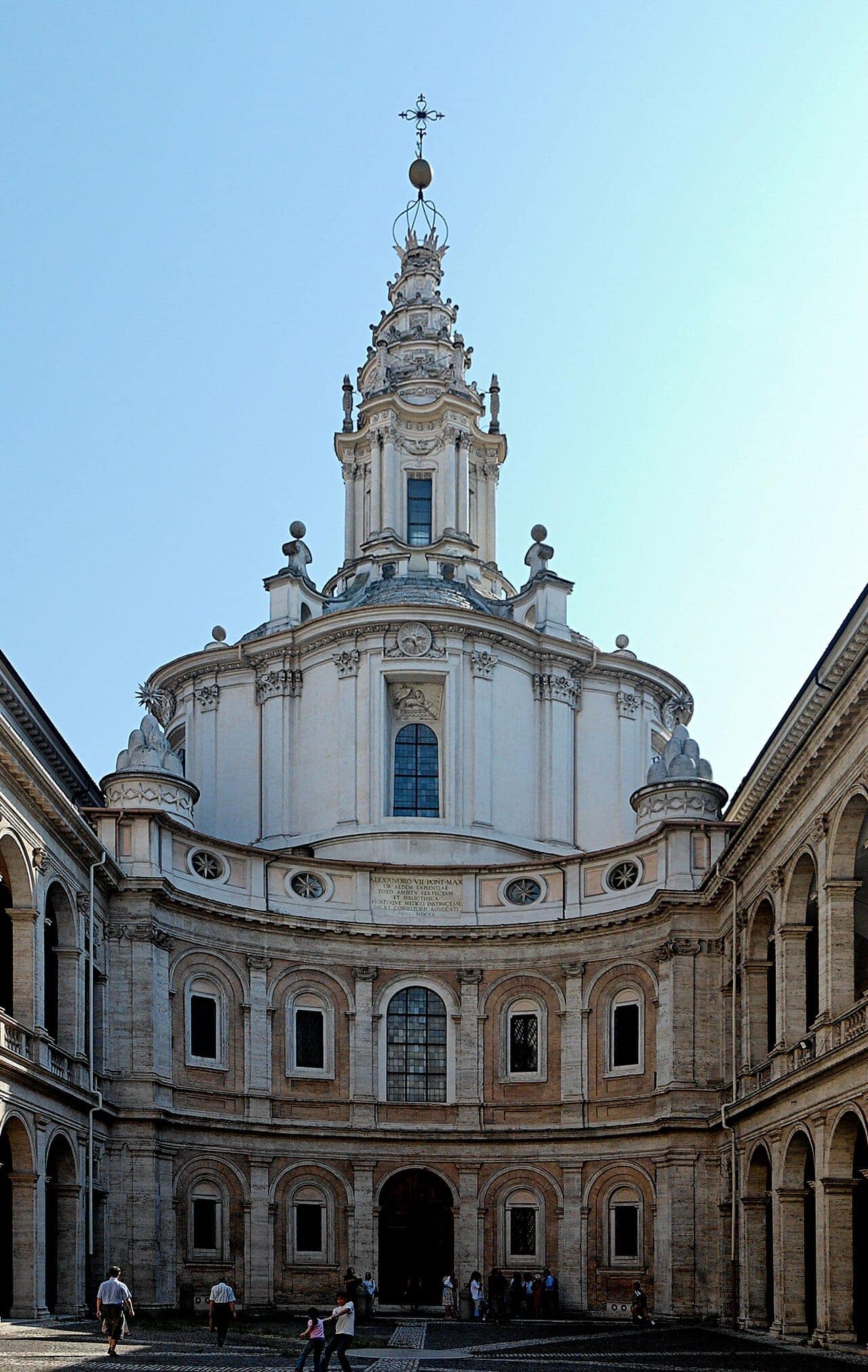
  • Distinctive spiral lantern profile
  • Architecture-focused stop near Pantheon and Navona

Notable artworks and details

  • Borromini's interior geometry
  • The spiral crown of the lantern as seen from outside and within the surrounding complex

How long to spend

  • Quick visit: Often a compact 15-25 minute architecture stop, with extra time if the courtyard and lantern are accessible.
  • Full visit: 30-45 minutes if you read the route notes, compare features, and slow down inside.
  • Add time if you are combining it with nearby churches in the same route cluster.

The common mistake is treating it like a normal quick church stop. Its value is architectural, and timing/access can matter more than with the core route churches.

How to fit it into your day

A sharp architecture detour just off the Navona and Pantheon orbit when you want to deepen the route.

Best route pairing

Pantheon-Navona architecture detour: around 45-75 minutes depending on pace and whether you keep the comparison tight.

  1. Start at San Luigi dei Francesi or the Piazza Navona side.
  2. Use Sant'Ivo alla Sapienza as the sharp architecture detour that deepens the route.
  3. Finish at Sant'Eustachio if you want the walk to settle back into the central cluster.

Architecture and style summary

This church is currently grouped under Baroque . This page helps visitors understand why certain interiors feel so immersive, and where to find the city's most memorable Baroque spaces without reducing them to single wow moments.

Area summary

Centro Storico works best for travelers who want a coherent walking plan rather than an isolated stop. This area works best as a planning hub rather than a single route. Use it when you want to decide whether the day should stay tightly around the Pantheon, hinge around Piazza Navona, widen west toward Campo de' Fiori and the river, or use Trevi as a shorter crowd-reset start. It is busiest by late morning, but the advantage is that these different central clusters all sit inside one highly walkable district.

Nearest landmarks and route anchors

  • Piazza Navona orbit
  • Sapienza complex
  • Easy link toward Sant'Eustachio and San Luigi dei Francesi

Best next moves

  • Best nearby next stop: Sant'Agnese in Agone. Easy to add on the same Centro Storico walk.
  • Best same-style follow-up: Sant'Eustachio. Good if you want another Baroque stop without losing route coherence.
  • Best route guide: Pantheon route. The clearest way to turn this church into a coherent walk.

Nearby and related churches

Use these next stops to keep the route coherent on the ground rather than doubling back across Rome for one isolated interior.

Useful route guides

Use these when you want Sant'Ivo alla Sapienza to sit inside a more realistic half-day walk or neighborhood sequence.