
Quick summary
- Best for
- Caravaggio, Bernini, illusion, chapel-rich interiors, and architecture-led church visits
- Time needed
- 60-90 minutes for one art cluster; half day only if combining central and Quirinale-side priorities
- Core churches
- 6
- Optional specialist depth
- 3 architecture or west-central extensions
Open these churches in Google Maps ->
This map follows the core route only. Keep the written guide for optional extensions and stop-by-stop judgment.
Before you start
If you only choose three
- San Luigi dei Francesi - best short Caravaggio stop in the historic center
- Santa Maria della Vittoria - best compact Bernini-sculpture payoff
- Sant'Ignazio di Loyola - best illusion-led church experience
These three give the fastest art-choice contrast: painting, sculpture, and illusion without forcing a longer citywide sweep.
Route summary
Choose this guide when the question is not 'which churches look beautiful?' but 'which artistic church experience fits me best?' San Luigi dei Francesi is the Caravaggio answer. Santa Maria della Vittoria is the Bernini-sculpture answer. Sant'Ignazio is the illusion answer. San Carlo and Sant'Andrea answer architecture. Minerva and Il Gesù give deeper full-interior or mixed-art experiences. The right outcome is a strong artistic choice, not the longest list.
Why choose this guide
Many Rome church pages mention art. That is not the same as helping someone choose the right art stop. A visitor with one free hour near Piazza Navona does not need the same answer as someone deliberately comparing Bernini and Borromini, and neither of them necessarily wants the same church as someone who cares most about painted spectacle.
- San Luigi gives the fastest serious painting stop.
- Santa Maria della Vittoria gives the clearest compact Bernini payoff.
- Sant'Ignazio changes how the room feels through illusion.
- Minerva gives deeper central substance, while Il Gesù gives whole-interior Baroque force.
- The Quirinale architecture pair exists for architecture-first visitors, not because the page needs filler.
How to use this guide
Start by choosing what kind of art experience you actually want most.
- Choose San Luigi dei Francesi for Caravaggio.
- Choose Santa Maria della Vittoria for Bernini sculpture.
- Choose Sant'Ignazio di Loyola for illusion and ceiling drama.
- Choose Santa Maria sopra Minerva for the broadest central mix of art, tombs, and historical depth.
- Choose Il Gesù for a full Baroque interior rather than a single chapel or artwork.
- Choose San Carlo alle Quattro Fontane and Sant'Andrea al Quirinale only if architecture itself is the priority.
Best artistic planning versions
You are more likely to remember one strong artistic cluster than a citywide art marathon.
- Best central painting and spectacle cluster: Santa Maria sopra Minerva -> San Luigi dei Francesi -> Sant'Ignazio di Loyola.
- Best Baroque interior and sculpture pairing: Il Gesù -> Santa Maria della Vittoria.
- Best architecture comparison: San Carlo alle Quattro Fontane -> Sant'Andrea al Quirinale.
- Use Santa Maria del Popolo or Santa Maria in Vallicella only when the route already begins or ends on their side of the center.
How long to spend
Treat these as artistic decisions, not as a race to collect decorated churches.
- One focused art answer: 15-30 minutes.
- One compact central cluster: 60-90 minutes.
- Central plus Quirinale-side architecture: half day.
- San Luigi and Santa Maria della Vittoria are the shortest successful answers; Minerva and Santa Maria del Popolo reward slower looking.
What to do next
Use this guide when the real question is which artistic church experience you want most. Once the artistic answer is clear, move into the route family that serves it best.
- Use the Pantheon guide when the day already belongs to one compact central cluster.
- Use the Campo de' Fiori guide when Il Gesù or Vallicella is winning and the route is already moving west.
- Use the Best Churches guide when art is only one part of a broader first-trip decision.
- Use the Free Churches guide when no-ticket value matters more than artistic category.
Core route and optional additions
Stop 1
Painting
San Luigi dei Francesi
A compact but essential church near Piazza Navona, especially for visitors who want one short central stop with very high artistic return.
This is the Caravaggio answer. If your real question is where to get the fastest serious painting payoff in a church, this is it. The Contarelli Chapel does the work quickly and decisively, which is why the church belongs here as the cleanest painting-led stop in the set.
Stop 2
Sculpture
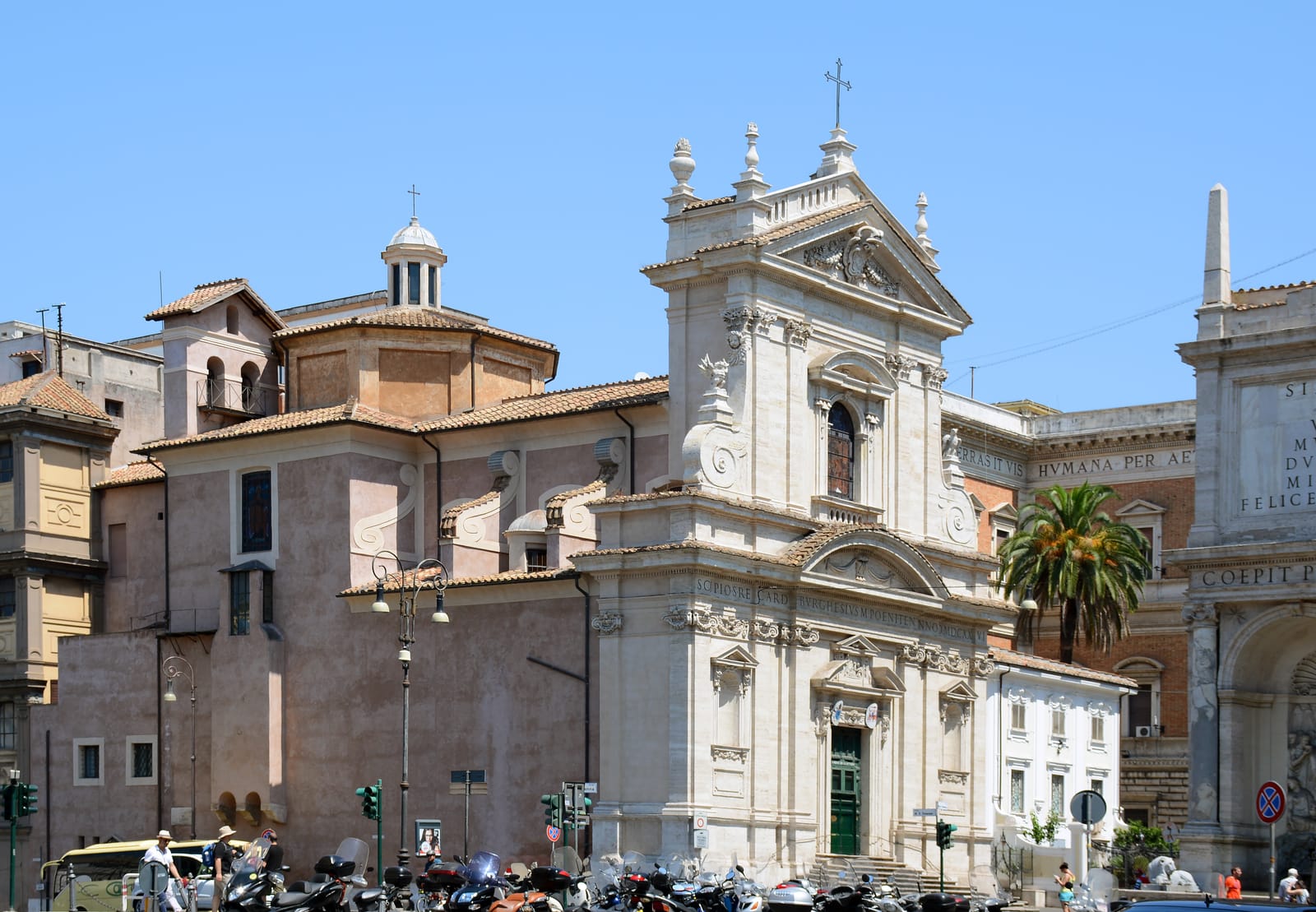
Santa Maria della Vittoria
A compact but high-impact Quirinale-side church that can turn a short visit into one of the most memorable Baroque stops in central Rome.
This is the Bernini-sculpture answer. It earns its place because it gives one of the clearest compact art experiences in Rome: high drama, high recognition, and immediate payoff. Visitors who want one unforgettable short stop can often end the search here.
Stop 3
Illusion
Sant'Ignazio di Loyola
A vivid central Baroque church whose illusionistic interior makes it one of the most memorable short art-and-architecture stops near the Pantheon side of Rome.
This is the illusion answer. The point is not only decoration but the way the church changes once you look up and understand how the space is being manipulated. It gives a different artistic reward from chapel painting or sculpture, which is exactly why it belongs in the core comparison.
Stop 4
Central depth
Santa Maria sopra Minerva
The strongest Pantheon-side church for visitors who want substance as well as convenience: Gothic bones, Dominican history, Michelangelo's Risen Christ, Filippino Lippi's Carafa Chapel, major tombs, and Bernini's elephant outside.
This is the all-round central-depth answer. It suits visitors who want a church where artistic richness builds through the whole visit rather than concentrating into one famous moment. Minerva gives structure, tombs, Michelangelo, and longer historical substance in a way the quicker single-payoff churches do not.
Stop 5
Interior impact
Il Gesù
One of the clearest central churches for understanding Roman Baroque theatricality, Jesuit ambition, and why some interiors in Rome feel built to overwhelm rather than simply decorate.
This is the interior-impact answer. It belongs here because some visitors are not looking for one masterpiece but for the force of a church that works persuasively as a whole. Il Gesù gives that more clearly than most churches in Rome, especially when a full Baroque interior matters more than one chapel or one artwork.
Stop 6
Chapel concentration
Santa Maria del Popolo
An art-rich church at the northern gateway to the center, strong for travelers interested in chapels, patronage, and the way art changes the feel of an urban threshold.
This is the chapel-concentration answer. It earns its place because it rewards slower looking and offers a richer north-center art stop than a quick square-side add-on. It is best when the day already begins or ends near Piazza del Popolo.
Stop 7
Optional west-central extension
Santa Maria in Vallicella
A larger Baroque church that gives the Campo de' Fiori and Chiesa Nuova side of Rome one of its best interior anchors.
Use this when you want a west-central Baroque extension after Campo-side churches. It is useful, but not one of the first universal answers.
Stop 8
Optional architecture depth
San Carlo alle Quattro Fontane
A small but architecturally essential church near the Quirinale, especially rewarding for visitors who care about space, proportion, and Roman Baroque experimentation.
Use this when the visitor cares about Borromini, plan, movement, and architectural intelligence more than about painting or sculpture.
Stop 9
Optional architecture depth
Sant'Andrea al Quirinale
A compact Bernini church whose scale makes it especially rewarding for visitors who like architecture that can be understood in one focused stop.
Use this when the visitor wants Bernini architecture as a compact comparison to San Carlo's Borromini logic.
Choose a related route
Use one of these if you want a tighter route or a clearer next step.