
Trastevere
Santa Cecilia in Trastevere
Last updated: June 2026
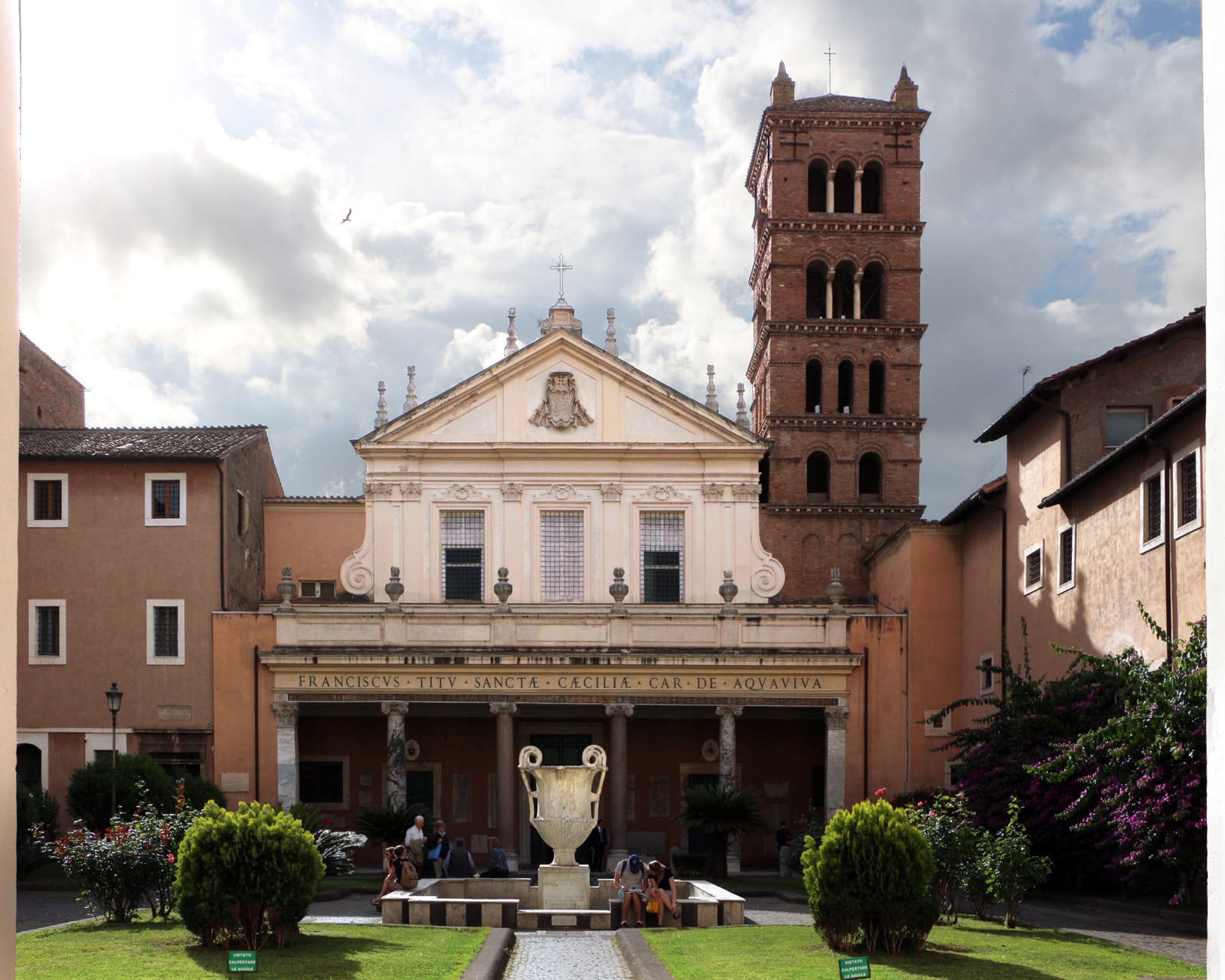
Photo by Sailko via Wikimedia Commons, licensed CC BY 3.0.
Santa Cecilia in Trastevere is the church to choose when you want martyr devotion, major medieval and Baroque art, and a quieter Trastevere destination all in one visit. Come for Stefano Maderno's Saint Cecilia, Pietro Cavallini's Last Judgment, the 9th-century apse mosaic, Arnolfo di Cambio's ciborium, and the archaeological levels below.
Quick summary
- Best visit length
- 45-60 minutes focused, longer if you add excavations or Cavallini access
- Do not miss
- Maderno's Saint Cecilia, Cavallini's Last Judgment, apse mosaic, Arnolfo di Cambio ciborium, underground remains
- Best route use
- Main art-and-devotion stop for a quieter Trastevere route
- Best next move
- Santa Maria in Trastevere for a broader district contrast, or San Francesco a Ripa if you want Trastevere to stay art-focused but less monumental
Plan your visit
Santa Cecilia works best as the deeper, quieter Trastevere church after or instead of the district's more obvious church stop.
Why this church matters
Santa Cecilia matters because it combines martyr memory, major artworks, and archaeological depth in a church that still feels devotional rather than museum-like. The site was founded before the 5th century and later rebuilt in basilical form under Pope Paschal I, giving the church a strong early-medieval backbone that still shapes the visit.
Its importance becomes clearer through named features. The 9th-century apse mosaic, Cavallini's rediscovered Last Judgment, Arnolfo di Cambio's ciborium, and Stefano Maderno's marble Saint Cecilia give visitors several specific reasons to remember the church. That range is unusual. Many Roman churches are known either for devotion or for art. Santa Cecilia is strong in both.
The attached monastery and the remains below the church deepen the impression that this is not a single-layer visit. Even though Santa Cecilia is not a San Clemente-style layered-history church, it still rewards visitors who want more than one surface-level reason to stop.
That difference matters. Santa Cecilia should not be written as the "other layered church" or as a backup to San Clemente. Its power is more devotional and artistic. The martyr memory of Cecilia, the physical immediacy of Maderno's statue, and the liturgical calm of the interior give the church a different emotional shape from archaeology-first churches.
It is also one of the best churches in Trastevere for visitors who want a district stop that feels chosen rather than incidental. Santa Maria in Trastevere dominates the piazza and the neighborhood imagination, but Santa Cecilia often becomes the church people remember more personally because its key features are so concentrated and so distinctive.
Another reason the church matters is that its features are unusually well balanced. The apse mosaic gives it early-medieval authority, Cavallini gives it late-medieval art importance, Arnolfo di Cambio gives it a strong Gothic marker, and Maderno gives it a devotional image with immediate emotional force. That sequence makes the church richer than a standard district stop.
The attached Benedictine identity strengthens that impression further. Santa Cecilia is not simply a church that once mattered. It still belongs to a religious environment that helps the visit feel inward-looking and coherent, even when the district outside is busy.
What to look for
Stefano Maderno's Saint Cecilia
This is the feature many visitors remember first. The statue makes the martyr memory immediate and human, giving the church a devotional center that is hard to forget. It also works as the church's clearest bridge between story and sight. Even visitors who know little about the saint usually understand from this sculpture that Santa Cecilia is not being remembered in a purely symbolic way.
Pietro Cavallini's Last Judgment
Cavallini gives Santa Cecilia its strongest single art-history claim. The fresco is the reason the church matters to many visitors who might otherwise pass it by. It keeps the visit from becoming only martyr devotion. Cavallini makes Santa Cecilia a real destination for serious church art within Trastevere.
9th-Century Apse Mosaic
The mosaic anchors the basilica in the Paschal I rebuilding and shows that Santa Cecilia's importance is not limited to one later artwork. It also gives the church a stronger historical backbone. Visitors who notice both the apse mosaic and Maderno's sculpture tend to understand the church as a long devotional story rather than a single famous object.
Arnolfo di Cambio's Ciborium
The signed Gothic ciborium is one of the clearest reasons to look at the altar area slowly rather than moving through it as background. This feature is especially useful for visitors who want the church to feel architecturally specific, not only emotionally resonant or artistically important.
Excavations And Ancient Remains
The remains below the church help the visit feel grounded in older Rome. They are most useful when treated as part of the church's identity, not a detached archaeological bonus. They also help explain why Santa Cecilia rewards slightly longer visits. The church is not only a statue and a fresco. It is one of those places where the surface and the underlying site reinforce each other. That is especially true for visitors who want Trastevere to feel historically layered without turning the whole day into a heavy archaeological route. Santa Cecilia gives you enough depth to change the mood of the district without taking over it completely.
Why visit
Visit Santa Cecilia when you want a Trastevere church with stronger memory value than its quieter location first suggests. It is especially good for visitors who want art and devotion to reinforce each other instead of feeling like separate motivations. If you are only choosing one church after Santa Maria in Trastevere, this is often the most rewarding second choice.
How long to spend
Common mistake: giving Santa Cecilia the leftover time after lunch or Trastevere wandering. It is stronger when chosen as a destination church within the district. Another common mistake is thinking the church will reveal itself instantly. Santa Cecilia often lands best after a few slow minutes because the features work together rather than shouting at the visitor all at once.
Build your day
Start here for a route that matches the day you actually want. Choose the onward line that fits your direction and attention level.
Best next moves
Nearby & Related Churches
Use these next stops to keep the route coherent on the ground rather than doubling back across Rome for one isolated interior.