
Quick summary
- Best for
- District walks, first serious Trastevere church visits, and slower west-bank half days
- Time needed
- 60–90 minutes for the core route; longer only with the southern continuation
- Core churches
- 3
- Optional additions
- 2
- Walking distance
- A compact Trastevere sequence that stays local and believable on foot
This map follows the core route only. Keep the written guide for optional extensions and stop-by-stop judgment.
Before you start
Best for first-time Trastevere visitors who want the district to feel church-led rather than restaurant-led.
Route summary
Choose this guide when you want one coherent Trastevere church walk once the main square alone no longer feels enough. Start with Santa Maria in Trastevere, move to San Crisogono to widen the district beyond the piazza, finish the core at Santa Cecilia, then decide whether the walk should end there or continue south toward San Francesco a Ripa.
Why choose this route
Trastevere has one of the clearest identity problems in Rome. It is famous enough that people think they already know what the district offers, but often what they really know is one piazza, one evening mood, and a vague idea that the neighborhood is atmospheric. This route fixes that by keeping the church logic local and deliberate.
- Santa Maria in Trastevere gives the walk its obvious anchor.
- San Crisogono broadens the district beyond the piazza without leaving its local shape.
- Santa Cecilia gives the route its quieter and more devotional finish.
How to use this guide
Treat this as the route you choose when Trastevere itself is the destination. The strongest version begins with the district's main anchor, adds one broader basilica pause, and then ends with the quieter church that proves the neighborhood has more to offer than first impressions suggest.
- If you want the clearest district answer, stay with the three-church core.
- If the walk still wants one stronger southern finish, continue to San Francesco a Ripa.
- If you are already deep in lower Trastevere and still want one more local layer, add Santa Maria del Orto only at the end.
Best 60–90 minute version
Santa Maria in Trastevere -> San Crisogono -> Santa Cecilia in Trastevere. This order works because it starts with the church most people already associate with the district, then broadens the route before narrowing into its quieter devotional finish. The walk stays inside Trastevere, avoids pointless doubling back, and feels like one neighborhood sequence rather than several competing ideas.
- Shorter version: Santa Maria in Trastevere plus Santa Cecilia if the district needs only one main anchor and one deeper contrast.
- Better version: keep San Crisogono in the middle so the route feels like a fuller Trastevere answer rather than a two-stop contrast pair.
- Do not add southern stops automatically. The core should stand on its own before the route asks for more.
How long to spend
Use these timings to keep the route local and rewarding without turning it into a district marathon.
- Santa Maria in Trastevere: 20–30 minutes.
- San Crisogono: 15–25 minutes.
- Santa Cecilia in Trastevere: 20–30 minutes.
- Core route: about 60–90 minutes.
- With one southern continuation: about 90–120 minutes.
What to do next
The core route ends after Santa Cecilia. From there, choose one next direction only if the district still has room in the day.
- Continue to San Francesco a Ripa, then add Santa Maria del Orto only if lower Trastevere is now the point rather than a leftover.
- Use the Sunset route when the next decision is no longer which churches belong to Trastevere, but what kind of evening route fits from here.
- Use the Vatican to Trastevere walk when the district is acting as the landing point of a corridor rather than the start of its own neighborhood route.
- Stop here if the route has done its job. A district route that ends cleanly is more useful than one that keeps widening until it stops feeling like Trastevere at all.
Core route and optional additions
Stop 1
District anchor
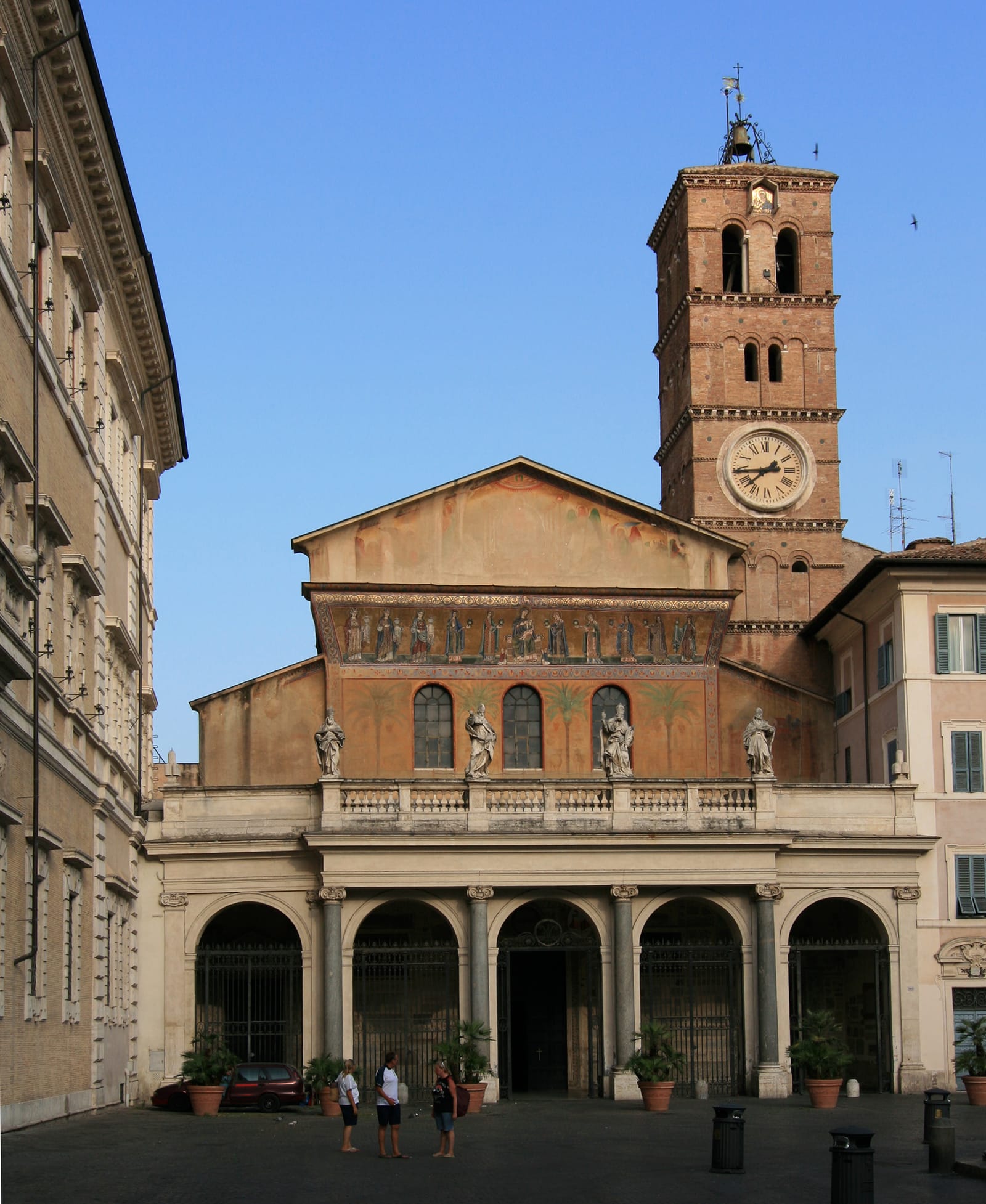
Santa Maria in Trastevere
The essential Trastevere anchor, rewarding not just for its fame but for the way mosaics, square, and neighborhood atmosphere reinforce one another.
Start here if you want Trastevere to declare itself immediately. Santa Maria in Trastevere is the church that makes the district legible: mosaics, square, basilica presence, and neighborhood identity all reinforce one another. If this stop is missing, the route stops feeling like the main Trastevere answer and starts feeling like a side-note version of the district. It belongs first because it gives the walk its orientation and its scale.
Stop 2
Middle basilica breadth
San Crisogono
A broad under-visited basilica in Trastevere that gives the neighborhood a more serious church presence beyond its most famous piazza stop. It works best for visitors who want trastevere church walks while keeping the surrounding walk coherent.
Continue here when you want Trastevere to widen beyond the square without losing its local shape. San Crisogono gives the route the thing many neighborhood walks lack: a true basilica pause with space, column rhythm, and a quieter arrival than the main lanes. It is the stop that helps the district feel larger in church terms, not just livelier in street terms.
Stop 3
Quieter devotional finish
Santa Cecilia in Trastevere
A Trastevere church that offers quieter sacred atmosphere than the district's main square, especially useful once you want the neighborhood to feel deeper than its postcard image.
Finish the core here when you want the district to become more inward and more memorable. Santa Cecilia is where the route deepens: martyr devotion, major art, calmer setting, and the sense that Trastevere has moved beyond surface atmosphere into something more concentrated. It works as the natural quiet finish because it deepens the Trastevere walk without pulling you out of the district.
Stop 4
Optional southern continuation
San Francesco a Ripa
A southern Trastevere church with stronger local texture than many central headline stops, worthwhile for visitors who like focused Baroque interiors and neighborhood context.
Use this when the walk should finish deeper in southern Trastevere rather than taper back toward the main square. San Francesco a Ripa is the most convincing extra step because it gives the route one calmer local ending rather than a vague sense that you should see more of the district.
Stop 5
Optional local add-on
Santa Maria del Orto
A southern Trastevere church that rewards slower neighborhood walking and helps the district feel broader, calmer, and more local than its best-known square.
Use this only when you are already committed to lower Trastevere and want the southern lanes to feel more complete. It is not required for the route to make sense. It is the extra local layer, not the proof that the route was worth doing.
Choose a related route
Use one of these if you want a tighter route or a clearer next step.