
Quick summary
- Best for
- No-ticket church planning, budget-conscious days, and choosing high-value free experiences
- Time needed
- 60-90 minutes for one strong free cluster; longer only if one basilica becomes the anchor
- Core churches
- 7
- Optional or friction-aware additions
- 3
Open these churches in Google Maps ->
This map follows the core route only. Keep the written guide for optional extensions and stop-by-stop judgment.
Before you start
If you only choose three
- Santa Maria sopra Minerva - best free central-depth answer near the Pantheon
- San Luigi dei Francesi - best free short-art payoff
- Santa Maria in Trastevere - best free atmosphere answer
These three create the strongest free central-versus-atmosphere contrast if you want value without paid planning.
Route summary
Choose this guide when you want strong church visits without relying on ticketed attractions. Minerva is the best free central-depth answer. San Luigi is the fastest free art answer. Sant'Ignazio is the illusion answer. Il Gesù is the full Baroque interior answer. Santa Maria in Trastevere is the atmosphere answer. Santa Maria Maggiore is the city-basilica answer. Santa Sabina is the calm answer. St Peter's still belongs, but only as exceptional value with real friction.
Why choose this guide
Many churches in Rome are free to enter. That sounds useful until you realise how easy it is to burn time on weak stops just because they cost nothing. This page only works if it stays strict about value. A church belongs here because the main visit gives enough back to justify the walk, not because the door happens to be open.
- San Luigi gives fast art value.
- Sant'Ignazio gives fast visual payoff.
- Minerva gives richer central depth.
- Santa Maria in Trastevere gives neighborhood atmosphere.
- Santa Maria Maggiore gives basilica scale without Vatican-style friction.
- Santa Sabina gives calm, while St Peter's belongs only under a friction-aware rule.
How to use this guide
Decide first what kind of no-ticket value you want.
- Choose San Luigi dei Francesi if you want the fastest serious free art payoff.
- Choose Santa Maria sopra Minerva if you want one central free church with more depth.
- Choose Sant'Ignazio di Loyola if visual spectacle matters more than chapel-focused art.
- Choose Il Gesù if you want a full Baroque interior rather than a short single-work stop.
- Choose Santa Maria in Trastevere if you want atmosphere to matter as much as the church itself.
- Choose Santa Maria Maggiore if you want major basilica scale without the Vatican queue profile.
- Choose Santa Sabina if the best answer is calm and early-Christian clarity.
- Choose St Peter's Basilica only if you accept the friction because the scale still makes it worthwhile.
Best no-ticket planning versions
The strongest no-ticket day is usually one compact cluster or one major anchor, not an endless free-entry sweep.
- Best central free cluster: Santa Maria sopra Minerva -> San Luigi dei Francesi -> Sant'Ignazio di Loyola.
- Best Trastevere free cluster: Santa Maria in Trastevere -> Santa Cecilia in Trastevere -> San Francesco a Ripa.
- Best basilica-scale free choice: choose between Santa Maria Maggiore and St Peter's Basilica.
- Pick Maggiore for practicality. Pick St Peter's only if the friction is acceptable because the scale itself is the point.
How long to spend
A free day still becomes expensive in energy if you zigzag between basilicas, Pantheon stops, and Trastevere just because admission is open.
- One compact free cluster: 60-90 minutes.
- One free basilica anchor: half day if it becomes the main destination.
- One free neighborhood answer: 30-75 minutes depending on whether the route deepens.
- Central art and illusion stops are shortest; Santa Maria Maggiore and St Peter's need more deliberate time.
What to do next
Use this guide when the question is which free churches in Rome are actually worth your time. Choose a different guide when the question changes.
- Use the Art Lovers guide when artistic category matters more than no-ticket value.
- Use the Best Churches guide when the decision is broader than budget or free access.
- Use the Pantheon or Trastevere guides once one free cluster has clearly won.
- Use the Major Basilicas guide when the real comparison is between Rome's biggest church anchors rather than free entry alone.
Core route and optional additions
Stop 1
Free art and central depth
Santa Maria sopra Minerva
The strongest Pantheon-side church for visitors who want substance as well as convenience: Gothic bones, Dominican history, Michelangelo's Risen Christ, Filippino Lippi's Carafa Chapel, major tombs, and Bernini's elephant outside.
This is the best free central-depth answer. It earns its place because the main church visit already gives serious artistic and historical return without needing museum-style planning or a paid add-on.
Stop 2
Free art and central depth
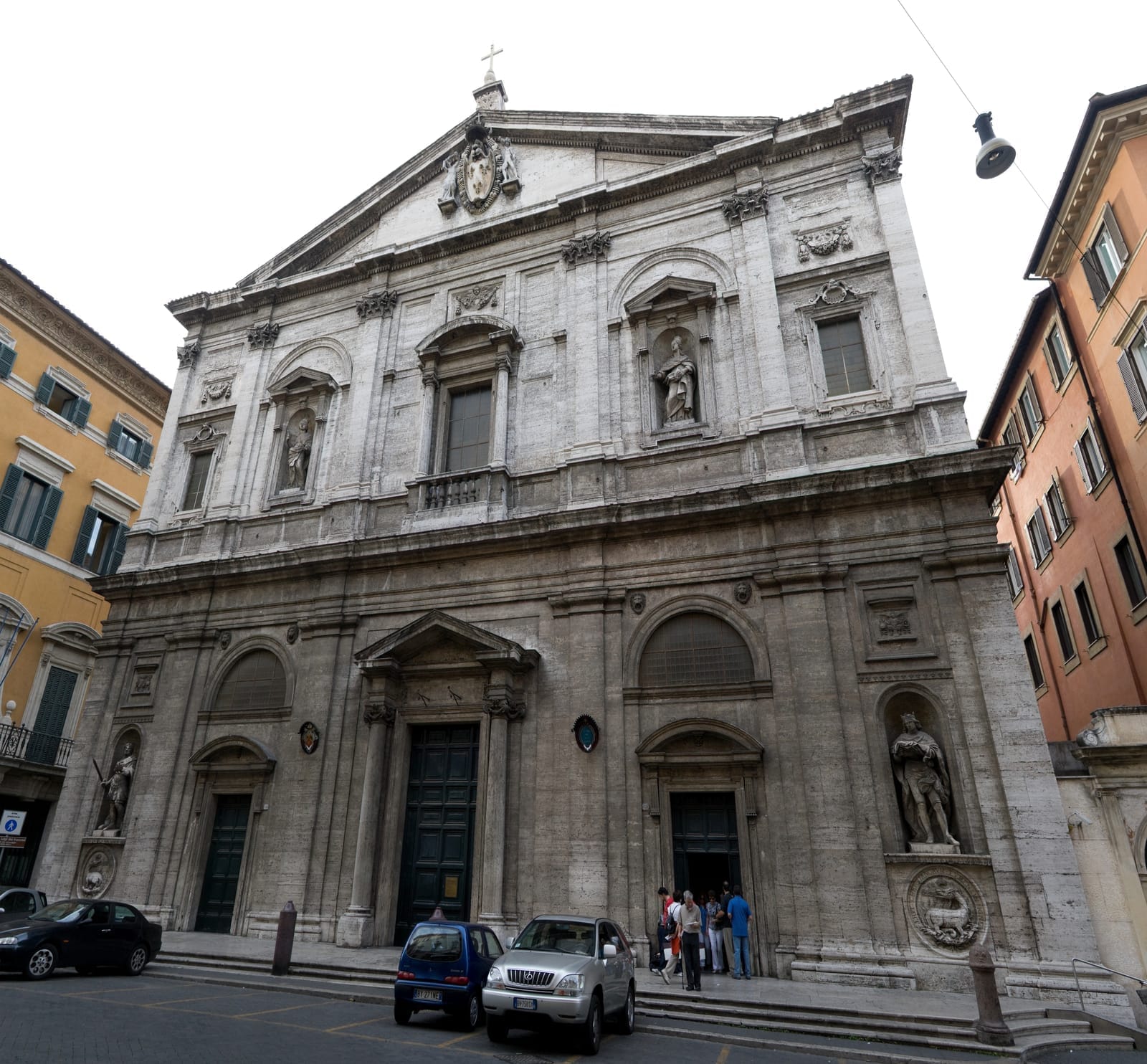
San Luigi dei Francesi
A compact but essential church near Piazza Navona, especially for visitors who want one short central stop with very high artistic return.
This is the best free short-art answer. It remains one of the clearest cases where a brief stop still feels culturally substantial because the Caravaggio payoff is so concentrated.
Stop 3
Free art and central depth
Sant'Ignazio di Loyola
A vivid central Baroque church whose illusionistic interior makes it one of the most memorable short art-and-architecture stops near the Pantheon side of Rome.
This is the best free illusion answer. It belongs here because the visual memory arrives quickly and costs nothing, making it one of the strongest high-impact free choices in the center.
Stop 4
Free interior impact
Il Gesù
One of the clearest central churches for understanding Roman Baroque theatricality, Jesuit ambition, and why some interiors in Rome feel built to overwhelm rather than simply decorate.
This is the best free Baroque interior answer. Use it when the free value needs to come from the power of the whole church rather than one chapel or painting cycle.
Stop 5
Free atmosphere
Santa Maria in Trastevere
The essential Trastevere anchor, rewarding not just for its fame but for the way mosaics, square, and neighborhood atmosphere reinforce one another.
This is the best free atmosphere answer. It belongs because the mosaics, piazza life, and district identity combine into one of the strongest no-ticket neighborhood church experiences in Rome.
Stop 6
Free basilica scale
Santa Maria Maggiore
One of Rome's essential basilicas, especially useful for travelers based near Termini who want a major church that is both historically rich and practical to reach.
This is the best free city-basilica answer. It remains the right choice when you want major-church scale, devotion, and visual richness without the queue logic of St Peter's.
Stop 7
Free calm
Santa Sabina
A calm Aventine basilica with early-Christian clarity, famous carved wooden doors, and one of Rome's best contrasts to decorative central churches. It works best for visitors who want aventine routes while keeping the surrounding walk coherent.
This is the best free calm answer. Its value comes from stillness, light, basilica clarity, and the Aventine setting rather than from spectacle or high-output decoration.
Stop 8
Optional neighborhood extension
Santa Cecilia in Trastevere
A Trastevere church that offers quieter sacred atmosphere than the district's main square, especially useful once you want the neighborhood to feel deeper than its postcard image.
Use this as a quieter Trastevere deepening stop when the district answer needs to become more devotional and inward.
Stop 9
Optional neighborhood extension
San Francesco a Ripa
A southern Trastevere church with stronger local texture than many central headline stops, worthwhile for visitors who like focused Baroque interiors and neighborhood context.
Use this when the no-ticket Trastevere route wants a southern finish rather than ending at the main square.
Stop 10
Exceptional value despite friction
St Peter's Basilica
Rome's most important basilica for most visitors, but strongest when treated as a planned sequence: Michelangelo's Pieta, the nave, Bernini's baldachin over the papal altar, the crossing, and the apse with the Chair of St Peter.
Use this as the exceptional-value answer when you accept queues and security because the scale, significance, and experience still make the free visit worth it. It belongs here, but under a different rule from the rest of the page.
Choose a related route
Use one of these if you want a tighter route or a clearer next step.