
Trastevere
Santa Maria in Trastevere
Last updated: June 2026
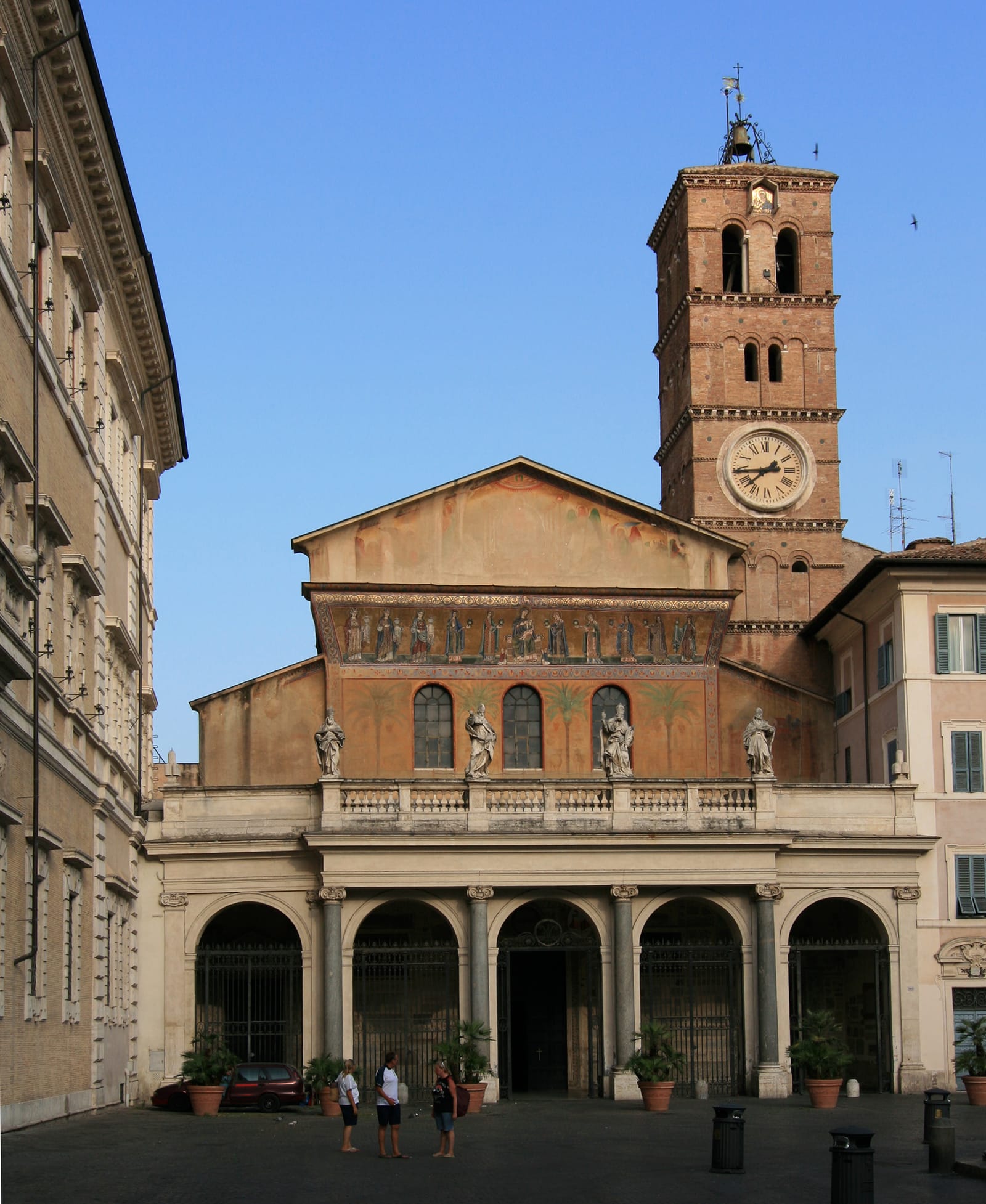
Photo by Jensens via Wikimedia Commons, released to the public domain.
Santa Maria in Trastevere is the church to choose when you want one basilica that feels inseparable from its neighborhood yet still carries real Roman church weight. Come for the Marian and early-church tradition, the 12th-century rebuilding, the apse mosaics, Pietro Cavallini, and a Trastevere route position that works as more than a pretty piazza stop.
Quick summary
- Best visit length
- 35-50 minutes focused, or about 1 hour if you want to slow down on the mosaics
- Do not miss
- Apse mosaics, Pietro Cavallini, Romanesque bell tower, Marian identity, the piazza setting
- Best route use
- Main church anchor for a Trastevere half day or a slower west-bank church sequence
- Best next move
- Santa Cecilia in Trastevere for a richer art-and-devotion continuation, or San Crisogono if you want the district to stay quieter and more local
Plan your visit
Santa Maria in Trastevere can anchor the district or act as the strongest first stop before moving into quieter Trastevere churches.
Why this church matters
Santa Maria in Trastevere matters because it joins early Roman church tradition, Marian identity, and one of the most recognizable neighborhood settings in the city. The church is traditionally linked to very early Christian worship in Rome, while the present building owes much of its character to the 12th-century rebuilding under Innocent II. That gives visitors a basilica that feels both deeply rooted and visually legible.
It also matters because the mosaics are not decorative extras. The apse and lower-zone mosaics are the clearest reason many visitors remember the church after they have forgotten the bustle outside. They turn the basilica into one of the strongest Trastevere stops for medieval Roman sacred art, and Pietro Cavallini's contribution gives the church a major art-historical reason for attention.
The living parish dimension matters too. Santa Maria in Trastevere remains a real church with visible charitable outreach and community life. That keeps the visit from feeling like a preserved monument detached from present-day religious meaning.
This is also why the church has more staying power than many district-famous landmarks. Visitors often arrive because the piazza is already on their route, but the basilica deserves stronger priority because it gives Trastevere a sacred center rather than merely a scenic one. If Santa Maria in Trastevere disappeared from the district, Trastevere would not only lose a beautiful church. It would lose one of the clearest places where local life, liturgy, and Roman church history still meet.
A careful distinction matters here. Santa Maria in Trastevere is not only important because it is old, and not only because it is beautiful. It matters because it carries Marian identity, significant mosaic work, a strong basilica presence, and a continuing parish life inside one of Rome's most visited neighborhoods.
That combination gives it unusually broad visitor usefulness. A first-time visitor can understand it quickly because the setting is so immediate. A more experienced visitor can keep returning because the mosaics, the rebuilding history, and the lived parish dimension hold up under closer attention. It is a church that works fast, but also grows when treated seriously.
What to look for
Apse Mosaics
These are the visual and spiritual center of the church. They are the reason the interior deserves concentrated looking rather than a quick loop before returning to the square. The apse is the point where the church stops being generic neighborhood beauty and becomes a major Roman basilica experience. If time is short, this is the part of the interior that must still get serious attention.
Pietro Cavallini
The lower apse mosaics matter because they move the church beyond general medieval atmosphere into named artistic importance. Cavallini gives Santa Maria in Trastevere a specific reason to stay in memory. This is also the feature that helps differentiate the church from other Marian or Trastevere stops. Visitors can remember not just "mosaics," but which mosaics and why they matter.
Romanesque Bell Tower
The bell tower helps explain the basilica from outside before you even enter. It gives the church one of its clearest skyline signatures in Trastevere. That exterior memory matters because Santa Maria in Trastevere is often encountered first through the life of the square. The bell tower helps anchor the church visually before the visitor has even crossed the threshold.
The 12th-Century Rebuilding
The present layout is largely the result of Innocent II's rebuilding. Remembering that gives the visit clearer historical shape and stops the church from feeling like a vague accumulation of centuries. The basilica has a legible historical body, not just a general sense of age.
Living Parish And Outreach
The church's continuing charitable work is part of why the visit still feels human and present. This matters especially for visitors who do not want sacred sites reduced to art containers. It also matters because it explains why Santa Maria in Trastevere still functions as a place of belonging for the district. For many visitors, that is what turns a central church stop into a more memorable encounter. Seen this way, the church becomes more than the district's most photogenic basilica. It becomes the place that helps the whole neighborhood feel spiritually anchored.
Why visit
Visit Santa Maria in Trastevere when you want one church that gives you both Roman church substance and neighborhood atmosphere without forcing a trade-off between them. This is one of the best choices in Trastevere for visitors who do not want to leave the district with only street-life memories and restaurant impressions.
How long to spend
Common mistake: spending all the energy on the piazza and giving the church the leftovers. The basilica is strongest when it becomes the reason for the stop, not the ornament beside it. Second common mistake: trying to see several Trastevere churches in a rushed sweep and flattening them into one memory. Santa Maria in Trastevere is usually better when it is allowed to dominate the district visit rather than share equal attention with every nearby stop.
Build your day
Start here for a route that matches the day you actually want. Choose the onward line that fits your direction and attention level.
Best next moves
Nearby & Related Churches
Use these next stops to keep the route coherent on the ground rather than doubling back across Rome for one isolated interior.