
Quick summary
- Best for
- Quieter routes, second visits, deeper Rome
- Time needed
- 60–90 minutes per cluster
- Number of churches
- 7
- Best areas to start
- Trastevere, Termini/Monti, Aventine, Colosseum edge
Before you start
Best for visitors who want quieter, more layered churches that still fit a real walking plan.
If you only choose three
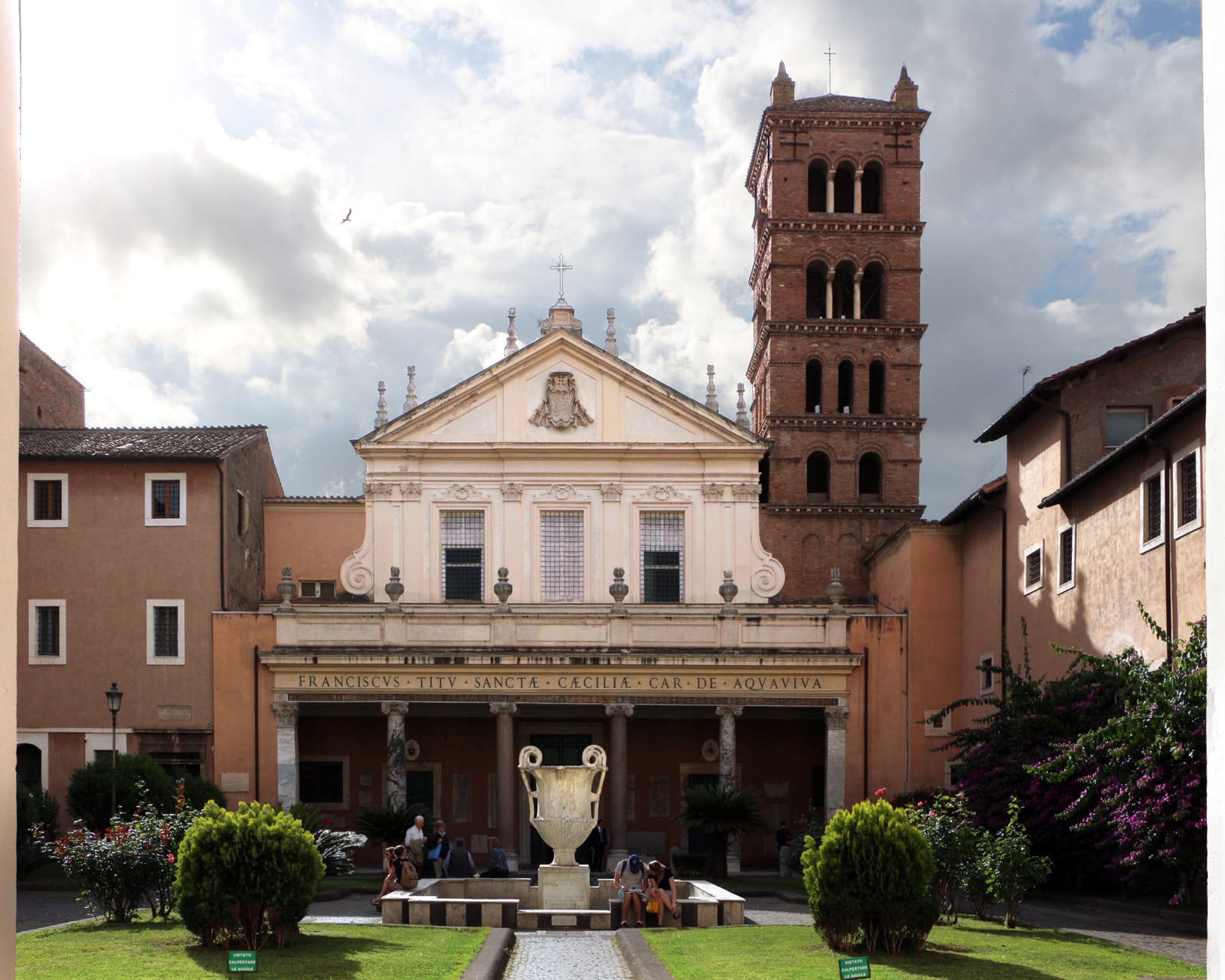
- Santa Cecilia in Trastevere - best Trastevere upgrade when you want the district to feel quieter and more devotional
- Santa Sabina - best calm hilltop church for early-Christian space, Aventine quiet, and a slower route
- San Clemente - best layered Rome experience when you want church, archaeology, and history in one stop
Use this shortlist as a practical starter set rather than trying to connect every hidden church in one sweep.
Route summary
Choose one overlooked cluster rather than chasing obscurity across the city. Trastevere, the Aventine, Termini/Monti, and the Colosseum edge each give you a different kind of quieter Rome, but they work best as separate half-day choices, not as one hidden-church trophy hunt.
What counts as hidden in Rome
A hidden Rome church is usually hidden by attention, not by location. Santa Cecilia is close to busy Trastevere, but many visitors never move beyond the main square. Santa Pudenziana sits near Santa Maria Maggiore, but the larger basilica absorbs the route. Santa Sabina is on a famous hill, but people often come for the viewpoint and miss the church that gives the Aventine its depth.
- Overlooked because it sits just off a main route.
- Under-prioritised because a bigger church nearby gets the attention.
- Hidden in plain sight because visitors know the name but rush the visit.
How this list was selected
Every church here had to improve a real walking plan. The point is not obscurity for its own sake; it is usefulness. A church had to offer one clear reason to visit, one concrete thing to notice, and one practical route benefit.
- A specific reason to stop: mosaic, doors, scale, setting, or layered history.
- A realistic location within a Trastevere, Termini/Monti, Aventine, or Colosseum-edge walk.
- Enough substance to justify a full church page, not just a passing mention.
Best way to use the guide
Do not try to visit all seven in one day. Choose one cluster and let it change the rhythm of the afternoon.
- Trastevere cluster: Santa Cecilia, San Crisogono, San Francesco a Ripa, 60–90 minutes.
- Termini/Monti cluster: Santa Pudenziana and nearby older churches, 45–60 minutes.
- Aventine cluster: Santa Sabina as the calm hilltop anchor, 30–45 minutes.
- Colosseum/layered Rome: use San Clemente as the deeper stop.
How to plan your time
Build the day around one quieter district, then stop once the route starts to stretch. The goal is depth within a neighborhood, not proving how many overlooked churches you can collect.
- Compact version: stay in Trastevere or on the Aventine and let the route stay local.
- Longer version: add a second cluster only if it follows naturally from where you finish.
- Let closures, services, or tired legs shorten the list rather than sending you across the city.
Stops in this guide
Stop 1
Trastevere beyond the main square
Santa Cecilia in Trastevere
A Trastevere church that offers quieter sacred atmosphere than the district's main square, especially useful once you want the neighborhood to feel deeper than its postcard image.
Stop here if Trastevere feels too busy and you want the district to become quieter, older, and more devotional. Santa Cecilia gives you a courtyard approach, a calmer interior, and a strong sense of stepping away from the restaurant streets into something more settled. The concrete reason to visit is the atmosphere around the saint's church and the way the complex slows the route down. It works best before San Francesco a Ripa or after Santa Maria in Trastevere, when you want the neighborhood to feel deeper than the main square.
Stop 2
Trastevere beyond the main square
San Crisogono
A broad under-visited basilica in Trastevere that gives the neighborhood a more serious church presence beyond its most famous piazza stop. It works best for visitors who want trastevere church walks while keeping the surrounding walk coherent.
Stop here if you are tempted to walk straight to the main Trastevere square but want space, scale, and an under-used basilica interior first. San Crisogono gives the route a broader nave, a strong column rhythm, and a quieter sense of arrival than the busier lanes nearby. It feels like Trastevere exhaling for a moment. The planning benefit is simple: it is a substantial pause between the river and the heart of the district, especially if you are building a 60–90 minute Trastevere church cluster.
Stop 3
Southern Trastevere with more substance
San Francesco a Ripa
A southern Trastevere church with stronger local texture than many central headline stops, worthwhile for visitors who like focused Baroque interiors and neighborhood context.
Stop here if you want southern Trastevere to feel substantial rather than peripheral. San Francesco a Ripa sits beyond the busiest lanes, which is why many visitors never reach it, but the church rewards the extra walk with a focused Baroque interior and a calmer local setting. It feels like the district has opened into a slower register. Route-wise, it pairs naturally with Santa Cecilia and gives a Trastevere walk a stronger finish than simply circling back to the main square.
Stop 4
Older Rome near Termini and Monti
Santa Pudenziana
A compact early-Christian church near Santa Maria Maggiore, best for visitors who want one of Rome's most rewarding older mosaic stops without the major-basilica crowds.
Stop here if you are near Santa Maria Maggiore and want one older, quieter church that changes the area's meaning. Santa Pudenziana is compact, but the reason to visit is serious: the apse mosaic and early Christian atmosphere give the Termini/Monti side more depth than a practical hotel district. It feels like finding an older layer just behind the obvious basilica route. Pair it with Santa Maria Maggiore or nearby older churches when you want a 45–60 minute cluster instead of a single stop.
Stop 5
Aventine calm beyond the viewpoint
Santa Sabina
A calm Aventine basilica with early-Christian clarity, famous carved wooden doors, and one of Rome's best contrasts to decorative central churches. It works best for visitors who want aventine routes while keeping the surrounding walk coherent.
Stop here if the Aventine is in your day and you want the hill to mean more than a view. Santa Sabina gives you early-Christian clarity, a calm nave, and famous carved wooden doors at the entrance. The experience is unusually restrained for Rome: spacious, quiet, and architectural rather than decorative. It is the best anchor for an Aventine cluster, especially with the Orange Garden or a descent toward Circus Maximus. This is where the hill starts to feel sacred, not just scenic.
Stop 6
Hilltop pauses away from the obvious route
Sant'Onofrio al Gianicolo
A quiet Janiculum church with a 15th-century cloister, Tasso associations, and enough hilltop atmosphere to justify the climb on a west-Rome route.
Stop here if you are willing to make the climb part of the experience. Sant'Onofrio al Gianicolo rewards the effort with a quieter hilltop setting, a cloistered mood, and a reflective pause above the city rather than another crowded central interior. The payoff is emotional as much as visual: the route feels like it has moved out of Rome's pressure and into a slower register. Use it after the Vatican or before dropping toward Trastevere when you want the walk itself to matter.
Stop 7
Layered Rome near famous landmarks
San Clemente
The clearest single church in Rome for seeing the city in layers: a 12th-century basilica above a 4th-century church, above Roman buildings and a Mithraeum, all close enough to the Colosseum to transform an ancient-Rome day.
Stop here if you want the city explained vertically: present church, earlier church, older structures below. San Clemente is widely known, but often misunderstood; many visitors treat it as a quick Colosseum stop, when it is one of the most complete examples of layered Rome. The concrete reason to slow down is the sequence of layers, not just the surface interior. It feels like stepping under the map of Rome. Use it as the deeper stop on a Colosseum-edge day rather than another quick tick-box visit.
Choose a related route
Use one of these if you want a tighter route or a clearer next step.