
Quick summary
- Best for
- Monti walks, neighbourhood church routes, and Colosseum-side half days
- Time needed
- 75-120 minutes for the full core route
- Core churches
- 4
- Optional additions
- 1
- Walking distance
- A one-direction route from upper Esquilino / Monti toward the Colosseum edge
This map follows the core route only. Keep the written guide for optional extensions and stop-by-stop judgment.
Before you start
Best for visitors who want one believable local route rather than a station-side chooser or a broad east-Rome shortlist.
Route summary
Choose this guide when you want the clearest church walk through Monti itself. Start with Santa Maria Maggiore, move through Santa Pudenziana and San Martino ai Monti to let the district take over, then finish at San Clemente if the route still wants a deeper Colosseum-side payoff. San Pietro in Vincoli can remain an optional branch, but it should not replace the main line.
Why choose this route
Monti is easy to flatten into geography. People know Santa Maria Maggiore is nearby, know the Colosseum is somewhere downhill, and assume the churches in between will sort themselves out. What usually gets lost is the feeling of the district itself. This route is useful because it gives Monti a real middle and a real finish instead of only a convenient start.
- Santa Maria Maggiore begins the route with scale.
- Santa Pudenziana changes the pace and makes the upper route feel layered.
- San Martino ai Monti is the point where the walk becomes recognisably Monti rather than just nearby to somewhere more famous.
- San Clemente gives the route a finish worth walking toward.
How to use this guide
Treat this as the route you choose when the neighbourhood itself matters.
- Use the full four-stop line when you want the clearest Monti answer.
- Keep San Martino ai Monti in the middle; without it, the route loses its local identity.
- Use San Pietro in Vincoli only if the day is bending toward the Forum side rather than toward San Clemente.
- Do not use this page as a substitute for broad early-Christian comparison.
Best 75-120 minute version
Santa Maria Maggiore -> Santa Pudenziana -> San Martino ai Monti -> San Clemente. This order works because it narrows properly after the major anchor, strengthens through a real Monti middle, and then finishes with a church that feels substantial enough to reward the full walk.
- Shorter successful version: Santa Maria Maggiore -> Santa Pudenziana -> San Martino ai Monti.
- Fuller version: keep San Clemente so the route ends with a true destination.
- Use San Pietro in Vincoli as a Forum-side branch, not as a replacement for the route's main middle or finish.
How long to spend
Suggested timings for a believable neighbourhood walk:
- Santa Maria Maggiore: 20-35 minutes.
- Santa Pudenziana: 15-20 minutes.
- San Martino ai Monti: 20-30 minutes.
- San Clemente: 25-40 minutes.
- Three-stop local version: about 60-85 minutes.
- Full four-stop route: about 75-120 minutes.
What to do next
The route can end successfully after San Martino ai Monti or continue to San Clemente when the day still wants the stronger lower-end payoff.
- Use Churches near Termini when the real question is still the station-base problem rather than the neighbourhood walk.
- Use Quiet churches near the Colosseum when the next decision is no longer the Monti line but which one church near the ancient core deserves time.
- Use Early Christian churches in Rome when you want to compare older Christian stops across districts instead of finishing the local walk.
- Stop at San Martino or San Clemente depending on how much of the route the day still wants. This page succeeds when Monti feels like a real route, not when it tries to absorb every nearby option.
Stops in this guide
Stop 1
Major anchor
Santa Maria Maggiore
One of Rome's essential basilicas, especially useful for travelers based near Termini who want a major church that is both historically rich and practical to reach.
Start here because it gives the route the scale that Monti alone cannot supply at the opening. Its job here is to anchor the top of the route before the neighbourhood narrows and deepens.
Stop 2
Quiet older stop
Santa Pudenziana
A compact early-Christian church near Santa Maria Maggiore, best for visitors who want one of Rome's most rewarding older mosaic stops without the major-basilica crowds.
Continue here when you want the route to settle. The church is smaller, quieter, and older-feeling, which makes it the right contrast after Maggiore and helps the route stop feeling monumental and start feeling layered.
Stop 3
True Monti middle
San Martino ai Monti
A layered Monti and Esquilino-side church that helps connect Santa Maria Maggiore, older basilica routes, and the quieter side of the district.
This is the true middle of the route. San Martino ai Monti gives the page its neighbourhood identity because it sits where the walk becomes recognisably Monti rather than just nearby to something more famous.
Stop 4
Primary finish
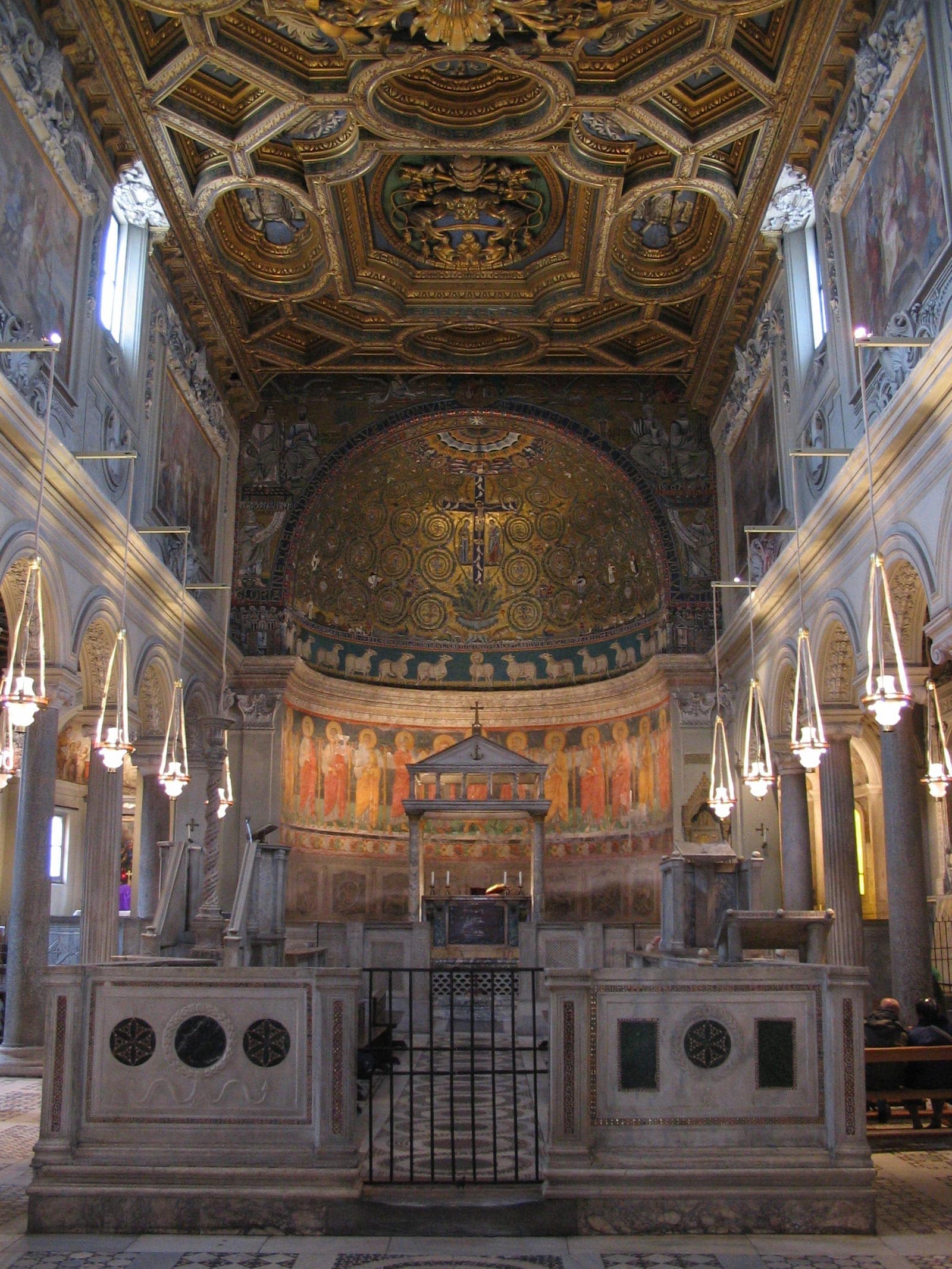
San Clemente
The clearest single church in Rome for seeing the city in layers: a 12th-century basilica above a 4th-century church, above Roman buildings and a Mithraeum, all close enough to the Colosseum to transform an ancient-Rome day.
Finish here when you want the walk to earn its lower-end payoff. San Clemente turns the Colosseum side into more than a simple downhill continuation and gives the route a finish worth keeping time for.
Choose a related route
Use one of these if you want a tighter route or a clearer next step.