
Esquilino & Monti
Santa Pudenziana
Last updated: June 2026
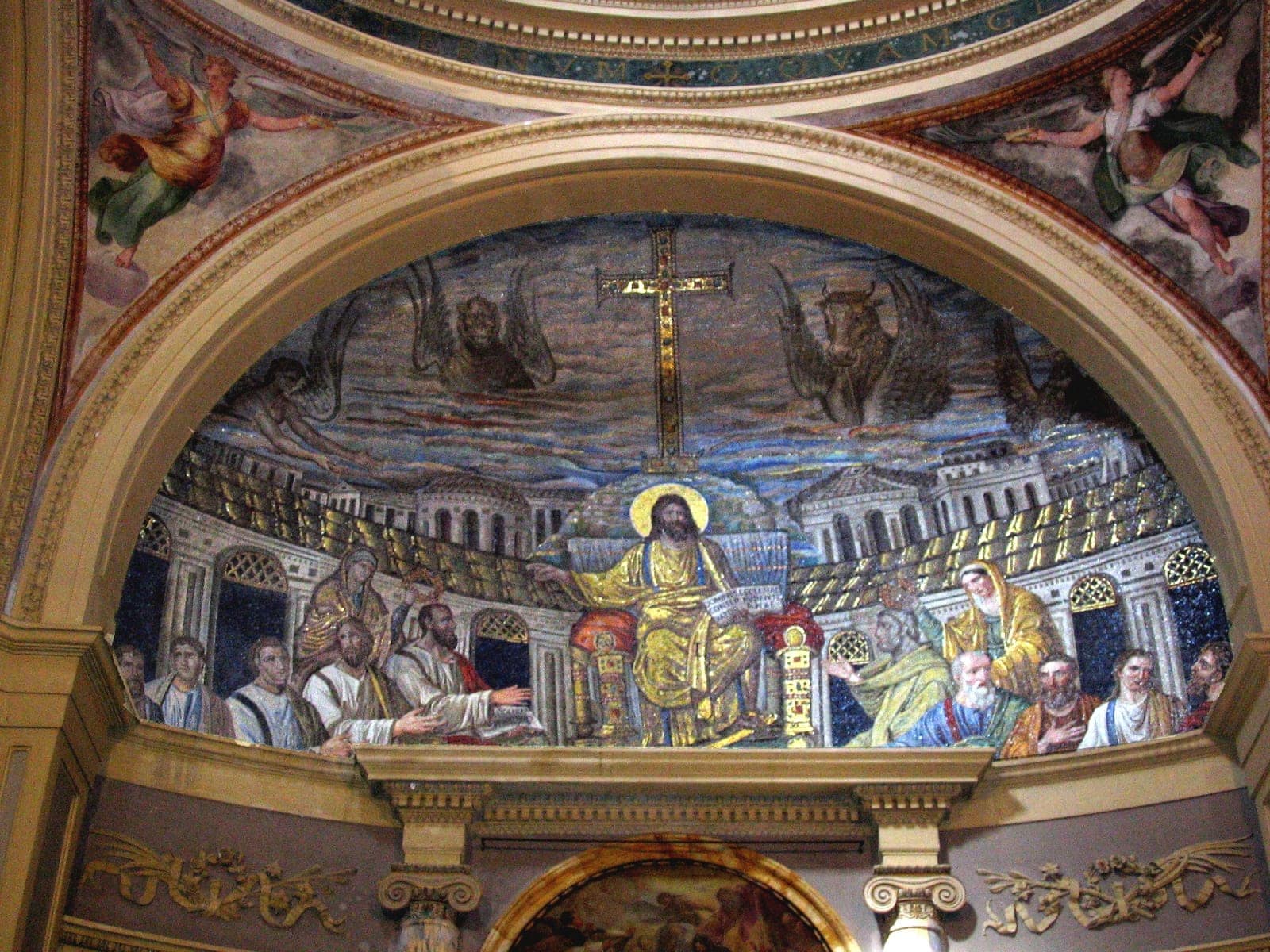
Photo by Sixtus, enhanced by TTaylor, via Wikimedia Commons, public domain.
Santa Pudenziana is the church to choose when you want one compact stop near Termini and Santa Maria Maggiore with unusually high early Christian weight. Come for the great apse mosaic, the 4th-century church fabric, the apostolic tradition linked to the site, the Roman remains below, and a route position that makes this one of the strongest smaller churches to add without turning the day into filler.
Quick summary
- Best visit length
- 25-40 minutes focused, or about 50 minutes if you slow down on the mosaic and excavated history
- Do not miss
- Apse mosaic, Roman domus remains, Caetani Chapel, early Christian context, Termini / Santa Maria Maggiore route role
- Best route use
- Best compact early Christian extension from Santa Maria Maggiore, Termini, or the Monti side
- Best next move
- Santa Maria Maggiore for a larger basilica pairing, or San Martino ai Monti if the route should deepen into Monti
Plan your visit
Santa Pudenziana works best as a compact upgrade to a Santa Maria Maggiore, Termini, or Monti-side route. It is not a day anchor by itself, but it is one of the best short additions in this part of Rome.
Why this church matters
Santa Pudenziana matters because it gives visitors an early Christian church of real seriousness in a part of Rome where people often move too quickly between station logistics and larger basilicas. The official site dates the current structure to the 4th century, which already makes the church more significant than its modest first impression suggests.
Its identity deepens through the tradition that the church stands over the domus of Pudens, associated with Peter and Paul, with earlier remains surviving below. That tradition needs careful wording, but it still shapes the church's devotional and historical atmosphere without forcing certainty beyond the available evidence.
The apse mosaic is the feature that transforms the visit from "small church near Termini" into something memorable. The official site dates it to the early 5th century and presents it as foundational for later Christ Pantocrator imagery. Whether or not the visitor arrives already knowing that term, the point is simple: this is one of the churches where early Christian visual language becomes unusually vivid.
Santa Pudenziana should not be dismissed simply because the footprint is compact. The church has a high ratio of significance to size. It offers early Christian fabric, serious mosaic value, strong apostolic-site tradition, and useful route placement all at once. Many larger churches in Rome cannot match that density.
It is also one of the best churches for showing how caution and importance can coexist. Disputed oldest-church claims should not be overstated, but the church should not be flattened into timidity either. Santa Pudenziana is important enough on the evidence already.
What to look for
The Apse Mosaic
This is the church's defining feature and the reason Santa Pudenziana matters so much. The mosaic gives the visit its strongest memory and should be treated as the center of the church, not one detail among several. If the mosaic lands properly, visitors understand immediately why the church deserves time despite its modest scale.
Christ Pantocrator Imagery
The official site presents the mosaic as important in the later development of Christ Pantocrator imagery. That makes the church especially valuable for visitors who want to understand how early Christian art shaped later visual traditions. Even visitors unfamiliar with the term can still benefit from the idea behind it: this is one of the places where Christ is presented with unusual authority and clarity in a way that later Christian art would keep developing.
Roman Domus Remains
The remains below help the church feel rooted in older Rome rather than suspended as an isolated sacred interior. They also support the church's apostolic-site tradition. They are especially useful for visitors who want the church to feel historical in more than one dimension. Santa Pudenziana is not only about one mosaic above ground; it is also about continuity beneath the floor.
Caetani Chapel
This feature gives the visit a later, more layered interior note and helps stop the church from feeling like a one-feature stop. That matters because the church should not collapse into a single-image destination. The chapel shows that Santa Pudenziana continued to gather meaning across later centuries as well.
Medieval Exterior Traces
The 12th-century portal and bell tower show that Santa Pudenziana should be read as a church that kept evolving, not as a single frozen early-Christian survival. This is a useful reminder for route planners too. The church is compact, but it is not simple. Visitors who take one more minute outside and inside usually leave with a fuller sense of its timeline.
Why visit
Visit Santa Pudenziana when you want one stop that makes the Santa Maria Maggiore / Termini side feel more intelligent and less generic. It is especially good for visitors who care about early Christian Rome, mosaics, and apostolic tradition but do not have the time or energy for another sprawling major church.
How long to spend
Common mistake: assuming the church is too small to matter. Santa Pudenziana is one of those places where knowing what you are looking at changes the whole experience. Another mistake is treating it as interchangeable with any other compact church near Termini. Santa Pudenziana is stronger than that because the early Christian and mosaic claims are unusually weighty.
Build your day
Start here for a route that matches the day you actually want. Choose the onward line that fits your direction and attention level.
Best next moves
Nearby & Related Churches
Use these next stops to keep the route coherent on the ground rather than doubling back across Rome for one isolated interior.