
Esquilino & Monti
San Clemente
Last updated: June 2026
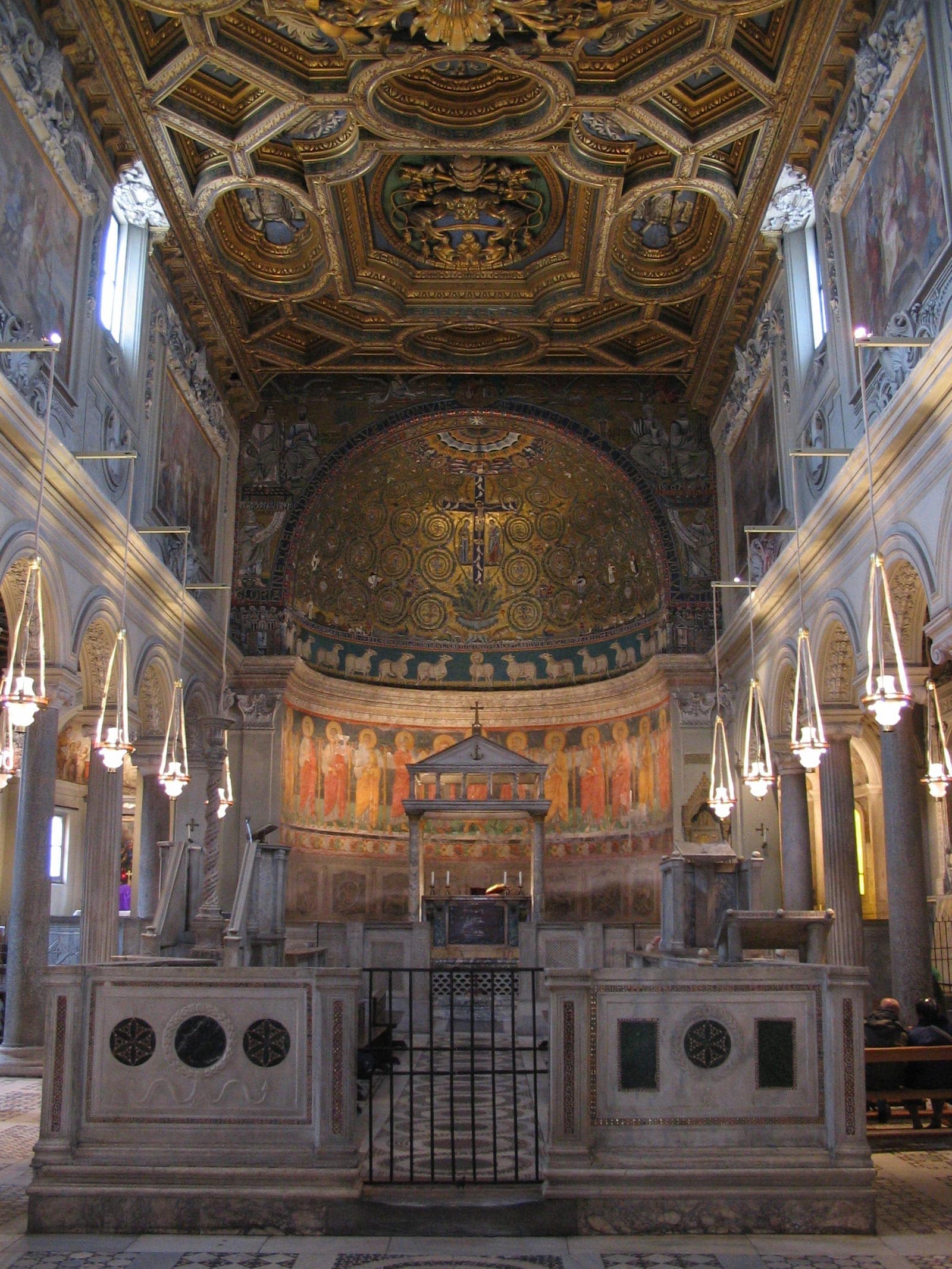
Photo by Sixtus via Wikimedia Commons, licensed CC BY-SA 3.0.
San Clemente is one of the few places in Rome where you can walk from a medieval basilica into an earlier church, down through Roman buildings, and finally into a Mithraeum. Near the Colosseum but far richer than a rushed add-on, it is the church to choose when you want apse mosaic, lower-basilica frescoes, St Cyril, and the buried city to make one connected visit.
Quick summary
- Best visit length
- 60-90 minutes recommended, longer if you slow down in the excavations
- Do not miss
- Apse mosaic, lower basilica frescoes, Mithraeum, St Catherine chapel, St Cyril
- Best route use
- Deepest history stop between the Colosseum side, Monti, and St John Lateran
- Best next move
- Santi Giovanni e Paolo for a calmer Celio continuation, or St John Lateran for a wider basilica finish
Plan your visit
San Clemente works best as the deep-history anchor in a half day built around the Colosseum, Monti, or St John Lateran. It works badly as a token church stop after several ruins because the whole point is to follow the site downward and let the layers explain each other.
Why this church matters
San Clemente is unique in Rome because it lets you move physically through the city's religious history instead of just reading about it. You enter a 12th-century upper basilica, descend into an earlier lower basilica, continue into older Roman buildings, and end at the Mithraeum. Very few churches in Rome explain so clearly how Christian worship, older urban Rome, and competing religious worlds occupied the same ground.
It is also far more than an excavation site with a church on top. The upper basilica gives you one of Rome's great apse mosaics, Cosmatesque work, and the Chapel of St Catherine with Masolino. The lower basilica gives you frescoes, medieval devotion, the famous Sisinnius scene, and the memory of St Cyril. That combination is why San Clemente feels unforgettable even to first-time visitors with limited time.
What to look for
Apse mosaic of the Triumph of the Cross
Start here before you descend. The 12th-century apse mosaic turns the upper basilica into more than a waiting room for the excavations: Christ's cross rises like a living tree in a dense symbolic world that tells you immediately this church is artistically important in its own right.
Cosmatesque floor and 6th-century marble choir
The floor and marble enclosure help explain that the upper church is not just a shell above older layers. Look for the choir panels and the sense of liturgical structure still built into the space.
Chapel of St Catherine and Masolino
This is the upper church's most focused art-history stop. Masolino's fresco cycle gives San Clemente a real early Renaissance claim, so do not stay locked only into the underground story and miss one of the church's most refined painted spaces.
Lower basilica frescoes
The lower basilica is where San Clemente stops feeling like a normal church visit and becomes a descent into medieval Rome. Its frescoes preserve saints, donors, stories, and local devotional memory in a way that makes the underground feel inhabited rather than merely excavated.
The Legend of Sisinnius
This is the most famous single fresco stop below because of its early written Italian. Even visitors who are not chasing language history should use it as the moment where the lower church becomes specific and unforgettable.
Mithraeum and Roman layers beneath the church
The Roman levels beneath San Clemente are the reason the church is famous beyond normal basilica interest. You are not just seeing old walls under a church; you are moving into an older city and then into the Mithraeum, where the pre-Christian religious world still feels startlingly close.
St Cyril
San Clemente is also remembered as a place of pilgrimage. The site preserves the long association with St Cyril, and that devotional thread keeps the church from feeling like a historical specimen detached from living Christian memory.
Why visit
Choose San Clemente when you want one church that explains why Rome is different from anywhere else. St John Lateran gives bigger ecclesiastical scale and Santa Maria Maggiore gives a more ceremonial major basilica experience, but San Clemente is the clearest single choice near the Colosseum if you want sacred art, devotion, archaeology, and the buried city all working together.
How long to spend
Common mistake: treating San Clemente as the church version of a box-tick after the Colosseum. It is stronger when it gets your concentration early enough for the layers, not just your leftover time.
Build your day
Start here for a route that matches the day you actually want. Choose the onward line that fits your direction and attention level.
Best next moves
Nearby & Related Churches
Use these next stops to keep the route coherent on the ground rather than doubling back across Rome for one isolated interior.