
Esquilino & Monti
Santa Maria Maggiore
Last updated: June 2026
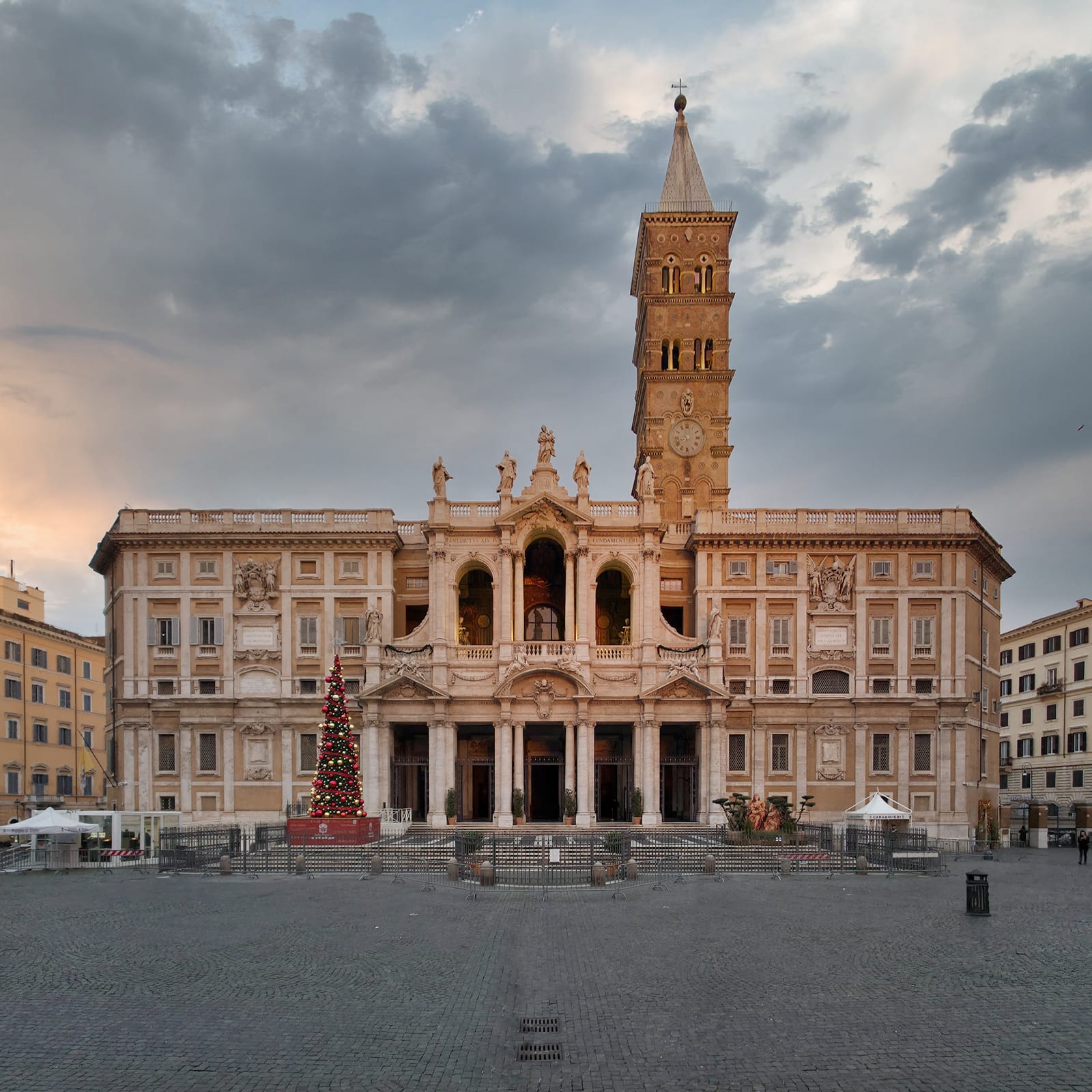
Photo by NateBergin via Wikimedia Commons, licensed CC BY 4.0.
One of Rome's four major papal basilicas, Santa Maria Maggiore is the major-church choice when you want sacred weight without making the whole day about the Vatican. Come for the fifth-century mosaics, the Salus Populi Romani icon, the Holy Crib tradition, Pope Francis' tomb, and a route position that works naturally from Termini, Esquilino, and Monti.
Quick summary
- Best visit length
- 45 minutes quick, 60-90 minutes recommended
- Do not miss
- Salus Populi Romani, fifth-century mosaics, Holy Crib, Pope Francis' tomb
- Best route use
- Start a Termini, Esquilino, Monti, or Lateran-facing walk here
- Best next move
- Santa Pudenziana for a compact mosaic stop, or San Clemente for layered history
Plan your visit
Santa Maria Maggiore works best as a route anchor, not as a quick tick-box stop. If your day starts near Termini, Esquilino, or Monti, it gives you major-basilica scale without a cross-city detour.
Why this church matters
Santa Maria Maggiore matters because it joins early Christian Rome, Marian pilgrimage, and papal history in one practical city church. Built in the fifth-century world shaped by the Council of Ephesus, it preserves some of Rome's most important early Christian mosaics and remains one of the four major papal basilicas.
Its devotion to the Salus Populi Romani, the Holy Crib tradition, and Pope Francis' burial give the basilica a living pilgrimage role, not just historical importance. This is why the church deserves more than a quick look at its scale.
What to look for
Salus Populi Romani
The basilica's devotional heart is the Marian icon long linked with Rome, the popes, processions, and prayer. Do not treat it as just one chapel image; it explains why Santa Maria Maggiore remains a living pilgrimage church.
Fifth-century mosaics
Look along the nave and toward the triumphal arch. The Old Testament scenes and Incarnation imagery make the church one of Rome's clearest places to see early Christian visual culture inside an active basilica.
Holy Crib tradition
The basilica is closely associated with the Nativity through relics traditionally connected with the manger of Jesus. This gives Santa Maria Maggiore its strong Bethlehem and Christmas identity.
Apse mosaic by Jacopo Torriti
The medieval apse gives the far end of the basilica its Marian climax. Read it with the earlier mosaics and the church becomes a layered story rather than a single-period monument.
Arnolfo di Cambio's Nativity
This is the focused art-history stop for visitors interested in how Nativity devotion became visible in Rome. It is worth seeking out rather than treating as side decoration.
Pope Francis' tomb
Pope Francis' burial here gives the basilica a modern pilgrimage layer near the Marian icon he visited before and after apostolic journeys.
Why visit
Visit Santa Maria Maggiore if you want one church that feels both monumental and usable. St Peter's is the grandest papal experience, but it usually takes over the day. Santa Maria Maggiore gives you major-basilica weight, mosaics, Marian devotion, papal history, and a strong city route position without that same logistical burden.
How long to spend
Common mistake: do not rush in, see the scale, and leave. The basilica's meaning is in the sequence: mosaics, Marian icon, Nativity tradition, papal devotion, and onward route.
Build your day
Start here for a route that matches the day you actually want. Choose the onward line that fits your direction and attention level.
Best next moves
Nearby & Related Churches
Use these next stops to keep the route coherent on the ground rather than doubling back across Rome for one isolated interior.