
Centro Storico
San Nicola dei Lorenesi
Last updated: June 2026
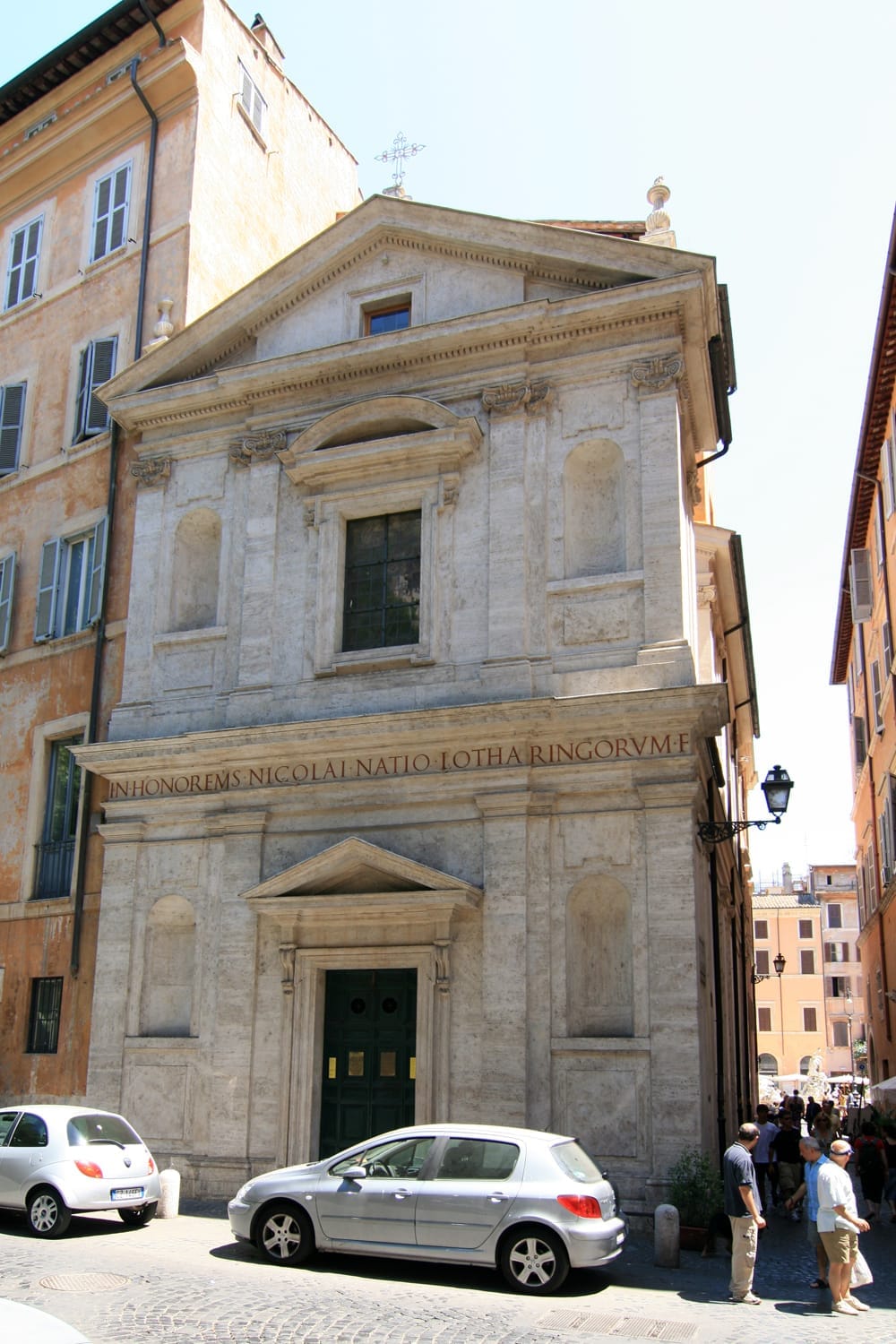
Photo by Jensens via Wikimedia Commons, public domain.
San Nicola dei Lorenesi is the church to choose when you want central Rome to feel less generic. Near Piazza Navona, it offers something the larger surrounding churches do not: the smaller scale and distinct identity of a Lorraine national church that still belongs to the living French-speaking Catholic map of Rome.
Quick summary
- Best visit length
- 10-15 minutes quick, 20-25 minutes if you are reading the church in the context of national-community Rome
- Do not miss
- Lorraine identity, French-speaking Catholic role, Giaquinto decoration, small-scale contrast
- Best route use
- Best as a Navona-side balancing stop between larger central churches
- Best next move
- San Luigi dei Francesi for the stronger French-linked anchor, or Sant'Agnese in Agone for a much larger piazza church
Plan your visit
Use San Nicola dei Lorenesi when the Navona side needs a church that changes scale and perspective. It is most rewarding when you already understand the larger nearby names and want one stop that explains how community churches also shaped Rome.
Why this church matters
San Nicola dei Lorenesi matters because it shows that Rome's sacred geography is not only papal and monumental. It is also made of national communities, expatriate devotion, and smaller churches that gave distinct groups a place in the city. Turismo Roma identifies it as the historic church of the people of Lorraine and one of Rome's French-speaking Catholic churches, which immediately gives it a different role from the heavyweights nearby.
That difference is why the church deserves time. Near Piazza Navona, where it would be easy to move only between famous facades and major art interiors, San Nicola adds a more intimate dimension. It makes the route feel inhabited rather than merely toured.
What to look for
The Lorraine identity
This is the real key to the church. The building matters because it belonged to a specific community, and that makes the stop feel more human than another anonymous Baroque interior in the center.
The Giaquinto decoration
Academic work links Corrado Giaquinto to an important eighteenth-century decorative intervention here, including the cupola Paradise and scenes of Saint Nicholas. Visitors may not know the name on arrival, but the church carries more artistic content than its size first suggests.
The small-scale contrast
What many visitors remember is not one isolated object but the relief of a quieter, lower-pressure interior after the larger neighboring churches. Here the smaller scale is the point, not a compromise.
Why visit
Choose San Nicola dei Lorenesi when the Piazza Navona route needs one stop that feels personal, local, and different in scale. It is especially useful if you enjoy seeing how Rome worked for communities as well as for popes, cardinals, and major religious orders.
How long to spend
Common mistake: expecting the church to behave like a small version of the big nearby showpieces. Its value comes from context, contrast, and identity.
Build your day
Start here for a route that matches the day you actually want. Choose the onward line that fits your direction and attention level.
Best next moves
Nearby & Related Churches
Use these next stops to keep the route coherent on the ground rather than doubling back across Rome for one isolated interior.