
Quick summary
- Best for
- Visitors who want a calmer south-Rome route with neighbourhood depth and a real hilltop finish
- Time needed
- 75-120 minutes depending on pace and whether you add the optional return branch
- Core churches
- 3
- Optional additions
- 2
- Walking distance
- A slower hill-and-neighbourhood route that works best when you let the Celio and Aventine shape the day
This map follows the core route only. Keep the written guide for optional extensions and stop-by-stop judgment.
Before you start
Use this guide when you want south Rome to become the destination rather than the overflow from another route. It is strongest for visitors happy to trade density for atmosphere and let the walk feel more residential, more reflective, and less pressured.
Route summary
This route links the Celio and Aventine into one coherent church walk. Start from the Lateran or the Celio edge, let the middle of the route slow down through Santi Giovanni e Paolo and San Gregorio al Celio, then finish with Santa Sabina as the calmest hilltop payoff in the family. If you still want to return toward the center, Aracoeli can provide that branch later. But the real success case is simpler: a south-Rome route that feels complete before the city starts pulling you back toward bigger landmarks.
Why choose this route
Many Rome church days get pulled toward the same central magnets. The Aventine and Celio solve a different problem. They give you churches that still matter, still reward attention, and still create a strong sequence, but with more space around them and less pressure to keep moving. That difference matters. This route is not just quieter for the sake of being quiet. It is quieter in a way that improves the visit. Santi Giovanni e Paolo gives the Celio real neighbourhood presence. San Gregorio al Celio slows the route further and changes its tone. Santa Sabina then turns the Aventine into a finish that feels earned. The key is the sequence itself: Celio depth first, then Aventine calm, with the route feeling local before it feels scenic.
Best 75-120 minute version
Take the route in this order and let the Celio middle do real work before the Aventine finish.
- Basilica dei Santi Giovanni e Paolo: start with real Celio presence rather than a rushed connector stop.
- San Gregorio al Celio: let the route deepen and slow down here.
- Santa Sabina: finish with the strongest calm hilltop payoff in the family.
How to use this guide
The best way to use this route is to let the neighbourhood sequence carry the day rather than overloading it with extra return logic.
- Enter from Lateran only if that is already where the day begins.
- Let the Celio middle do real work instead of treating it as scenery between anchors.
- Treat Santa Sabina as the proper finish.
- Add Aracoeli only if you need a return path toward the central city.
What to do next
Use one of these only when you are deliberately changing the shape of the walk after the south-Rome sequence has already worked.
- Use Churches near Circus Maximus when you are still solving the archaeological-edge transition rather than committing to the full quieter walk.
- Use Early Christian churches in Rome when the next choice is thematic and you want these churches inside a broader early-Christian frame.
- Use a central route only if you are deliberately returning to the center, not because this walk failed to complete itself.
Core route and optional additions
Stop 1
Celio depth
Basilica dei Santi Giovanni e Paolo
A Celio basilica with Romanesque exterior strength, a high bell tower, Cosmatesque portal, and access nearby to one of Rome's best preserved ancient residential complexes.
This church helps the route feel lived-in rather than strategic. It gives the Celio substance, not just scenery between better-known stops. Visitors remember the sense that the district itself finally matters here. It belongs early because it establishes the neighbourhood-led identity before the route becomes more contemplative.
Stop 2
Contemplative hinge
San Gregorio al Celio
A contemplative Celio church that gives the south-Rome and Colosseum side of the city a more monastic, reflective tone. It works best for visitors who want quiet churches near the colosseum while keeping the surrounding walk coherent.
San Gregorio is where the route changes tone. The walk stops feeling like a sequence of churches and starts feeling more reflective. That is why this stop is essential. Without it, the route would risk becoming just Lateran side to Santa Sabina. This is the point where many visitors feel the day slow down in the best way.
Stop 3
Aventine calm
Santa Sabina
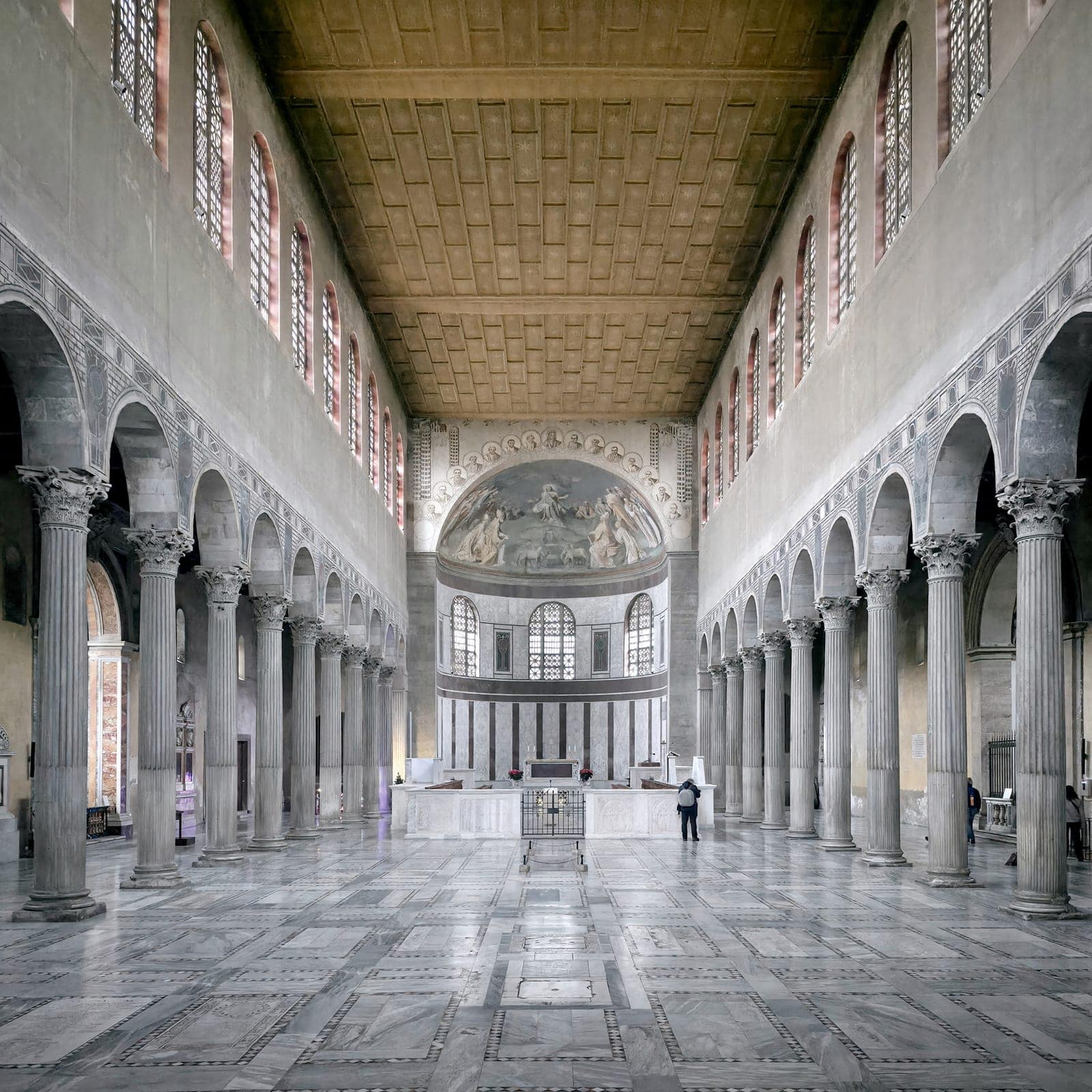
A calm Aventine basilica with early-Christian clarity, famous carved wooden doors, and one of Rome's best contrasts to decorative central churches. It works best for visitors who want aventine routes while keeping the surrounding walk coherent.
Santa Sabina is the finish that justifies the whole route. After the Celio middle, the Aventine should not feel like one more hill to climb. It should feel like the place the route has been quietly aiming for all along. What makes this work is not spectacle. It is calm, clarity, and the sense that the walk has reached the right ending.
Stop 4
Shared eastern anchor
St John Lateran
One of Rome's essential major basilicas and the clearest way to understand the city's ecclesiastical geography beyond the Vatican, with monumental scale, papal history, and a Lateran location that works best as its own focused stop.
Use Lateran when it genuinely helps you enter the route from the east. It works as a serious anchor, but it should not be treated as the emotional center of the page. If the route begins sounding like it exists mainly to justify Lateran, the south-Rome identity is already slipping.
Stop 5
Optional Capitoline return
Santa Maria in Aracoeli
A church that gives the Capitoline a sacred counterweight to the surrounding civic and ancient-Rome landmarks, especially useful when the area risks becoming all archaeology and viewpoint.
Add this only if you want to pull the walk back toward the center after the Aventine side. It is a useful branch, but not part of the route's core promise. The route succeeds perfectly well without it.
Choose a related route
Use one of these if you want a tighter route or a clearer next step.