
Aventine & South Rome
St John Lateran
Last updated: June 2026
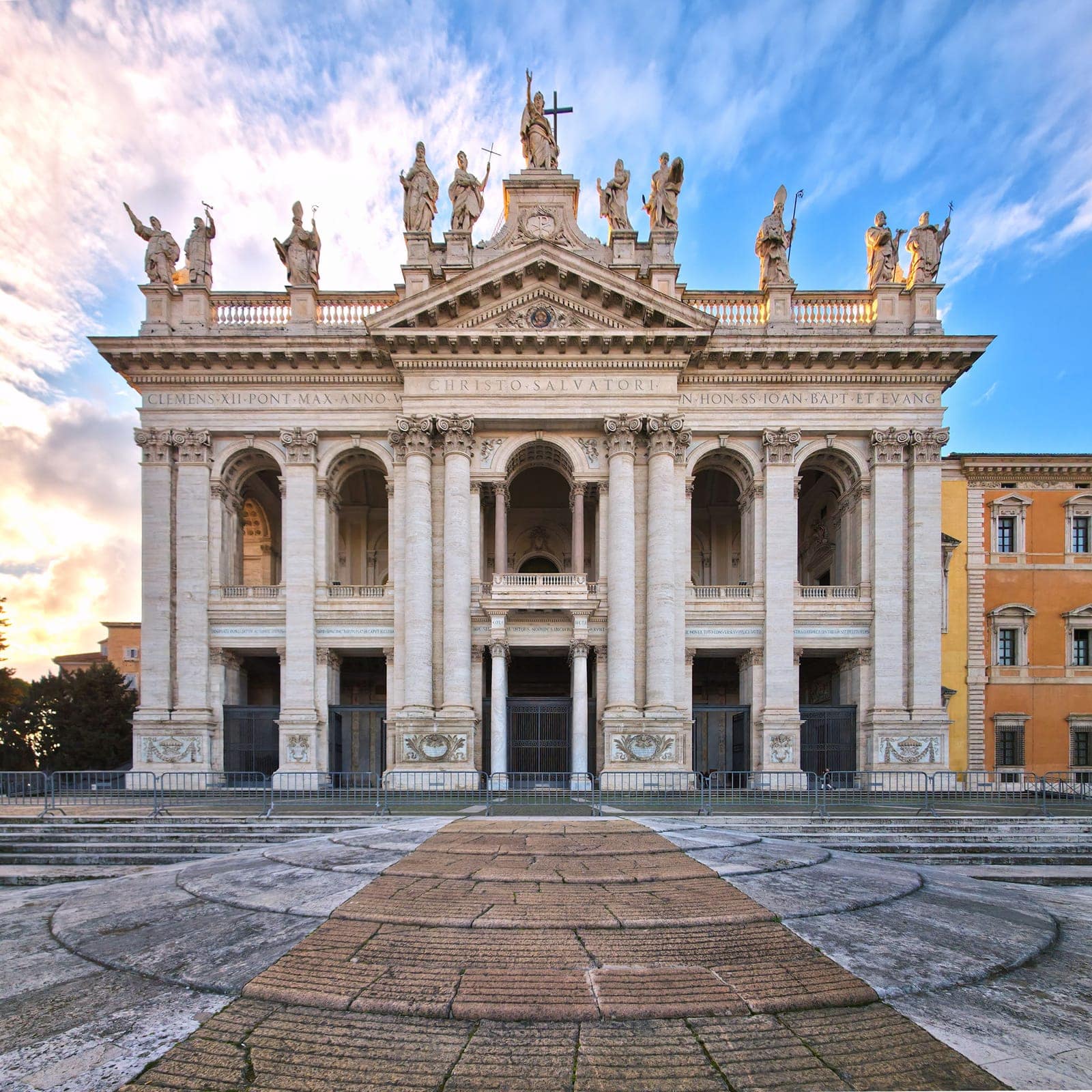
Photo by NateBergin via Wikimedia Commons, licensed CC BY 4.0.
St John Lateran is Rome's cathedral and the pope's official church as bishop of Rome, making it the most important church in the city's hierarchy and the one major basilica that explains how papal Rome worked beyond the Vatican. Come for the Apostles, the papal altar and relic tradition, the cloister, the Holy Stairs relationship, and a south-Rome route that rewards more than a quick facade stop.
Quick summary
- Best visit length
- 45-60 minutes quick, 75-120 minutes recommended if you add the cloister or nearby sacred sites
- Do not miss
- Apostles statues, papal altar and relic tradition, cathedral apse, Cosmatesque cloister, Holy Stairs
- Best route use
- Main anchor for a half day built around the Lateran, Holy Stairs, and the south side of Rome
- Best next move
- San Clemente for layered history, or Santa Croce in Gerusalemme for a stronger relic-and-pilgrimage continuation
Plan your visit
St John Lateran works best as the main anchor of a south-Rome church half day. It is weaker as a hurried add-on after the Colosseum because its meaning depends on understanding the cathedral, the Lateran complex, and the way papal Rome extends beyond the Vatican.
Why this church matters
St John Lateran matters because it is Rome's cathedral and the pope's official ecclesiastical seat as bishop of Rome. That is what makes it different from St Peter's Basilica. St Peter's dominates the imagination because of its scale and Vatican location, but Lateran is the church that explains authority, office, and the structure of Roman Catholic Rome. It is also the oldest public church in Rome and the highest-ranking of the papal basilicas.
Its importance is historical as well as liturgical. Built on the Constantinian site and long connected with the Lateran Palace, it was for centuries the centre of papal life in Rome. Councils met here, the popes resided here, and the complex still opens out into the baptistery, cloister, museum, and Holy Stairs relationship nearby. The result is not just one monumental interior, but a whole sacred district that shows how papal Rome functioned before the Vatican became the dominant visitor frame.
What to look for
Facade inscription and cathedral identity
The facade tells you immediately that this is not just another great Roman church. Look for the inscriptions that identify the basilica's dedication and its claim to be the Mother and Head of all churches. This is the public statement of why the Lateran matters in Catholic geography.
Ancient Senate doors
The central bronze doors originally belonged to the Curia, the Senate House of ancient Rome. Few visitors notice that one of the Roman Empire's most political buildings now forms part of Rome's cathedral, which makes the entrance itself a memorable bridge between imperial and Christian Rome.
Borromini's nave and the Apostles
Inside, the giant statues of the twelve Apostles give the nave its unforgettable rhythm. They are not just decoration: the official basilica reading ties them to Borromini's vision of the heavenly Jerusalem, making the interior feel like an apostolic cathedral rather than just a large basilica.
Papal altar and ciborium
The altar zone is where cathedral dignity becomes devotional focus. The Gothic ciborium commissioned in the fourteenth century marks the place where reliquaries associated with the heads of Saints Peter and Paul are kept, giving the basilica a relic tradition that many visitors miss if they only look at the nave.
Apse and cathedra
The apse matters because this is the end of the church that belongs to the bishop of Rome. Even if you are not reading every visual detail, use the apse and cathedral seat to remember that this is a functioning cathedral, not simply a historic monument.
Lateran cloister
The cloister is one of the strongest reasons not to rush the visit. Turismo Roma and the official site both treat it as a major part of the Lateran experience: a Cosmatesque masterpiece that preserves sculpture, fragments, and the quieter intellectual life of the complex.
Holy Stairs and Sancta Sanctorum
Even though they sit nearby rather than inside the nave, the Holy Stairs belong to the Lateran experience in visitors' minds. They connect the basilica to papal devotion, pilgrimage practice, and the old private chapel of the popes in the Sancta Sanctorum.
Why visit
Choose St John Lateran when you want to understand Rome's church hierarchy, not just admire one more huge interior. St Peter's is grander and more unavoidable for many visitors, but Lateran answers a different question: where is Rome's cathedral, and how did papal Rome work beyond the Vatican walls? If that question matters to you, this church deserves real time.
How long to spend
Common mistake: treating St John Lateran as the lesser version of St Peter's. It is better approached as Rome's cathedral and the key to understanding the city's sacred structure, not as a spare major basilica if you happen to be nearby.
Build your day
Start here for a route that matches the day you actually want. Choose the onward line that fits your direction and attention level.
Best next moves
Nearby & Related Churches
Use these next stops to keep the route coherent on the ground rather than doubling back across Rome for one isolated interior.
Related route guides
Editorial sources
- Archbasilica of Saint John Lateran
- Archbasilica of Saint John Lateran - Information and Timetables
- Archbasilica of Saint John Lateran - Borromini and the heavenly Jerusalem
- Archbasilica of Saint John Lateran - The relics
- Archbasilica of Saint John Lateran - The cloister
- The Basilica of St John Lateran - Turismo Roma
- The Pontifical Sanctuary of the Holy Stairs - Turismo Roma
- Encyclopaedia Britannica - Basilica of St John Lateran