
Quick summary
- Best for
- Short stays, weekend church trips, and visitors who want one central day plus one deeper second day
- Time needed
- Two half-to-full church days, depending on pace and how many optional layers survive
- Core churches
- 7
- Optional additions
- 1
- Planning rule
- Keep Day 1 compact and central; keep Day 2 weightier, slower, and clearly chosen
Google Maps links below cover each day separately.
Before you start
If you only choose three
- Santa Maria sopra Minerva - best Day 1 anchor for central substance and efficient walking
- San Clemente - best Day 2 depth stop because it gives the second day layered meaning rather than extra volume
- St John Lateran - best major anchor beyond the Vatican when the second day needs sacred-geography weight
These three show the split clearly: one central anchor, one interpretive depth stop, and one major second-day weight point.
Route summary
Choose this guide when you want two church-focused days that feel clearly different from each other. Use the first day for the strongest compact center: Minerva, San Luigi, and Sant'Ignazio, with Santa Maria in Vallicella only if the day still wants a westward broadening move. Use the second day for major depth: Santa Maria Maggiore, St John Lateran, San Clemente, and Santa Sabina in a rhythm that feels slower, more serious, and less crowded with extra decisions.
Why choose this itinerary
The strongest reason to use a two-day itinerary is not that Rome suddenly becomes manageable in forty-eight hours. It is that two days allow you to separate church experiences that would be cramped if they were forced into one line. Day 1 should feel efficient and rewarding. Day 2 should feel chosen for different reasons. That contrast is the value of the guide.
- Day 1 belongs to compact central art and substance.
- Day 2 belongs to major-church weight, layered meaning, and a calmer finish.
- The page fails if Day 2 reads like leftovers from Day 1.
How to use this guide
Build the two days with contrast in mind.
- Use Day 1 when you want density, high return, and a center that still feels walkable.
- Use Day 2 when you want scale, layered meaning, and a slower route that can handle one or two weightier churches properly.
- If Day 1 already feels full after Minerva, San Luigi, and Sant'Ignazio, cut Santa Maria in Vallicella first.
- If Day 2 is already strong after Maggiore, San Clemente, and Lateran, let Santa Sabina become the calm finish rather than another obligation.
Best planning versions
Each day should succeed before the full church count is exhausted.
- Day 1 shortest strong version: Santa Maria sopra Minerva -> San Luigi dei Francesi -> Sant'Ignazio di Loyola.
- Day 1 broader version: add Santa Maria in Vallicella only when the day still feels compact enough after the core.
- Day 2 strongest version: Santa Maria Maggiore -> St John Lateran -> San Clemente.
- Day 2 calmer full version: finish with Santa Sabina only when the second day still wants a quieter south-Rome ending.
How long to spend
Protect the split first. Day 1 should stay compact. Day 2 should stay slower and weightier rather than trying to catch up on volume.
- Day 1 core: about 2-3.5 hours.
- Day 1 with westward broadening: about 3-4.5 hours.
- Day 2 strongest version: about 3-5 hours.
- Day 2 with Santa Sabina: about 4-6 hours depending on pace and transfers.
What to do next
Use one of these if one day becomes the real center of gravity and you want a stronger route-family answer beneath it.
- Use Churches near the Pantheon or Churches near Piazza Navona when Day 1 wants a tighter central route on another visit.
- Use Rome's major basilicas when Day 2 becomes a basilica-comparison question rather than a pacing question.
- Use Aventine and Celio church walk when Santa Sabina changes the mood and the second day wants a quieter south-Rome continuation.
- If two days already feel complete, stop at two days.
Core route and optional additions
Stop 1
Day 1 central anchor
Santa Maria sopra Minerva
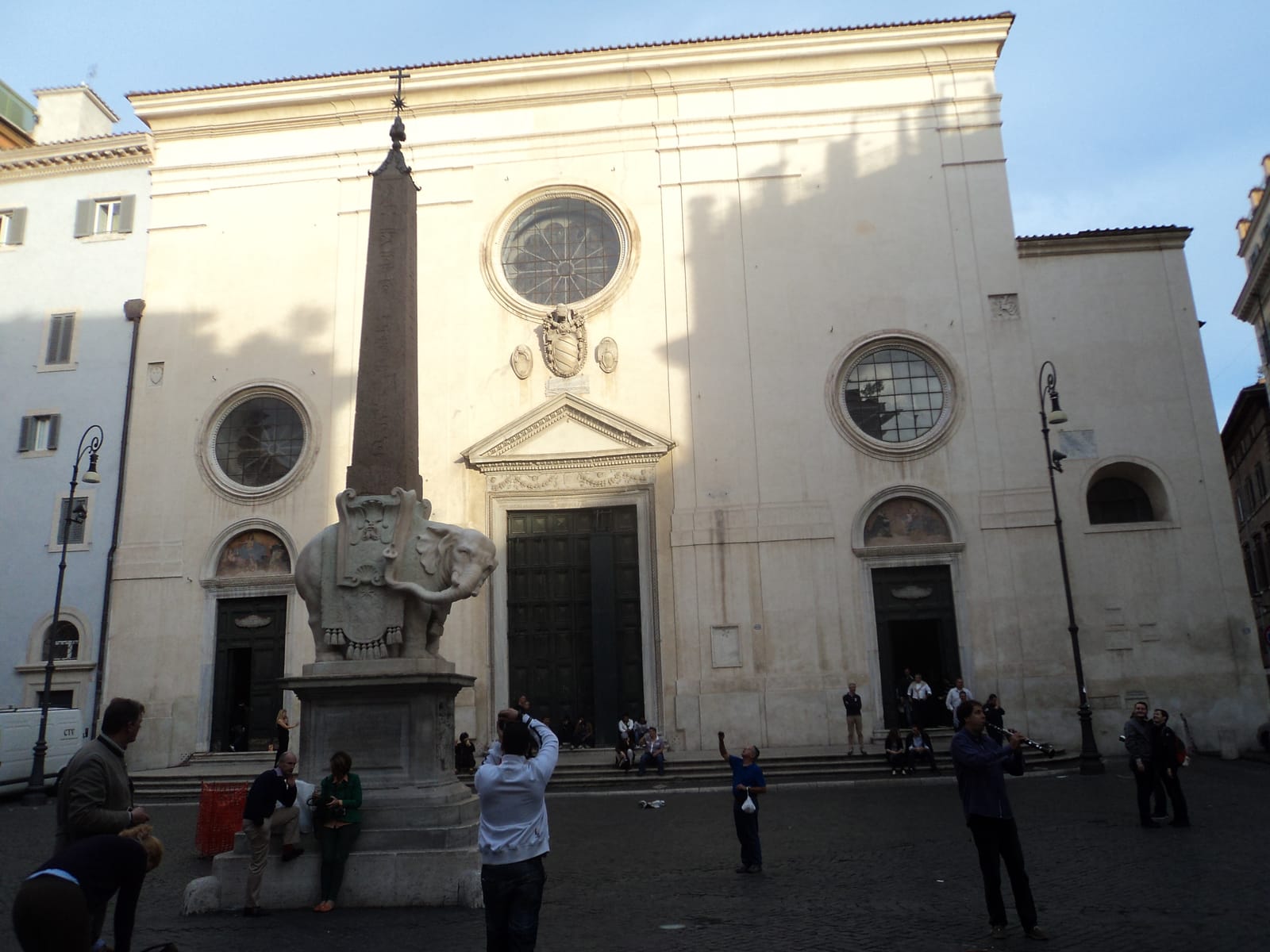
The strongest Pantheon-side church for visitors who want substance as well as convenience: Gothic bones, Dominican history, Michelangelo's Risen Christ, Filippino Lippi's Carafa Chapel, major tombs, and Bernini's elephant outside.
Start here when you want the central day to feel serious from the beginning. Minerva gives the route substance immediately: Gothic rarity, tombs, Dominican weight, and enough visual and historical density to justify making the church day central to the trip.
Stop 2
Day 1 art payoff
San Luigi dei Francesi
A compact but essential church near Piazza Navona, especially for visitors who want one short central stop with very high artistic return.
Continue here when you want one focused artistic payoff that keeps the central day efficient. San Luigi works because it is not sprawling. It gives the itinerary a compact Caravaggio answer and keeps the day moving.
Stop 3
Day 1 visual finish
Sant'Ignazio di Loyola
A vivid central Baroque church whose illusionistic interior makes it one of the most memorable short art-and-architecture stops near the Pantheon side of Rome.
Add this when you want the central day to end its core sequence with surprise rather than another version of the same mood. Sant'Ignazio lifts the day upward, visually and emotionally, without demanding a long stop.
Stop 4
Day 1 optional broadening
Santa Maria in Vallicella
A larger Baroque church that gives the Campo de' Fiori and Chiesa Nuova side of Rome one of its best interior anchors.
Use this only if Day 1 still feels open enough to widen. It is a good next move when the visitor wants one larger Baroque interior after the tighter core, but it should stay optional. If the center has already done its job, cut this first.
Stop 5
Day 2 basilica anchor
Santa Maria Maggiore
One of Rome's essential basilicas, especially useful for travelers based near Termini who want a major church that is both historically rich and practical to reach.
Start here when the second day needs major-church weight without giving itself wholly to Vatican logistics. Maggiore gives scale, Marian importance, and a practical east-side anchor.
Stop 6
Day 2 cathedral weight
St John Lateran
One of Rome's essential major basilicas and the clearest way to understand the city's ecclesiastical geography beyond the Vatican, with monumental scale, papal history, and a Lateran location that works best as its own focused stop.
Continue here when you want the second day to become more ecclesiastical and less central-tourist in tone. Lateran is not just another large church. It changes the meaning of the day by making Rome's sacred geography visible.
Stop 7
Day 2 interpretive heart
San Clemente
The clearest single church in Rome for seeing the city in layers: a 12th-century basilica above a 4th-century church, above Roman buildings and a Mithraeum, all close enough to the Colosseum to transform an ancient-Rome day.
Use this as the stop that gives Day 2 interpretive depth. After Maggiore and Lateran, San Clemente makes the second day feel layered rather than merely monumental. It is the church that explains why the day exists in this shape at all.
Stop 8
Day 2 calm finish
Santa Sabina
A calm Aventine basilica with early-Christian clarity, famous carved wooden doors, and one of Rome's best contrasts to decorative central churches. It works best for visitors who want aventine routes while keeping the surrounding walk coherent.
Finish here when the second day still wants a calmer answer. Santa Sabina gives the itinerary the restraint and light that the larger churches do not. It is the southern exhale that stops Day 2 from becoming a pile of heavy names.
Choose a related route
Use one of these if you want a tighter route or a clearer next step.