
Quick summary
- Best for
- Church-focused Rome trips, extended stays, and visitors who want a framework rather than a ranked list
- Time needed
- Three partial-to-full days, with one main church cluster per day
- Core churches
- 8
- Optional additions
- 2
- Planning rule
- Keep each day faithful to its own mood; cut optional connectors before overbuilding the trip
Google Maps links below cover each day separately.
Before you start
If you only choose three
- St Peter's Basilica - best Day 3 anchor for Vatican scale, significance, and the trip's biggest ceremonial church experience
- Santa Maria sopra Minerva - best Day 1 anchor for central art-and-substance depth
- San Clemente - best Day 2 depth answer because it turns the middle day into layered Rome rather than another large-church sequence
These three anchors show the framework clearly: one central day, one layered day, and one Vatican-scale day.
Route summary
Choose this guide when the trip is church-focused enough to justify three distinct days. Use Day 1 for the strongest central art-and-substance cluster, Day 2 for basilica and layered depth, and Day 3 for the contrast between Vatican scale and a calmer west-side landing. Think in day personalities, not in total church count.
Why choose this route
The value of a three-day church itinerary is not that it finally lets you do everything. Rome does not reward that mindset. The value is that it gives you enough time to let different kinds of church days exist beside each other without forcing them into one route.
- Day 1 should feel compact and high-return.
- Day 2 should feel heavier and slower.
- Day 3 should feel like a different ending mood rather than one more monument day.
- The connector churches must remain visibly secondary.
How to use this guide
Use the itinerary one day at a time.
- Let Day 1 stay compact and rewarding even if the trip is long enough for more.
- Let Day 2 carry the heavier churches only if you are willing to give them slower attention.
- Let Day 3 act as the contrast day rather than one more monument day.
- Cut connector churches before cutting the shape of a day.
Best framework versions
The strongest version of the trip is the one that protects three distinct day personalities before any optional widening moves are added.
- Strongest three-day framework: Day 1 = Minerva, San Luigi, Sant'Ignazio. Day 2 = Santa Maria Maggiore, San Clemente, St John Lateran. Day 3 = St Peter's Basilica, Santa Maria in Trastevere.
- Day 1 optional contrast: add Santa Maria del Popolo only if the trip still wants a north-side art widening move.
- Day 3 optional connector: add Santa Maria in Traspontina only if the Vatican-side sequence still needs one church-led bridge before the west-side landing.
How long to spend
The framework stays realistic only if the optional layers remain subordinate to the day identities.
- Day 1 core: about 2-4 hours.
- Day 2 core: about 3-5 hours.
- Day 3 core: about 3-5 hours depending on Vatican time and transitions.
- If the trip starts feeling overbuilt, cut Popolo or Traspontina before weakening a day's core personality.
What to do next
Use one of these if a single day becomes the real center of gravity and you want a tighter guide underneath it.
- Use Churches near the Pantheon or Rome churches for art lovers when Day 1 deserves a stronger central art follow-up.
- Use Rome's major basilicas or Early Christian churches in Rome when Day 2 becomes the trip's real center of gravity.
- Use Churches near the Vatican or Trastevere churches walk when Day 3 wants to become more route-specific on a future visit.
- If the framework already feels complete, leave it there.
Core route and optional additions
Stop 1
Day 1 central anchor
Santa Maria sopra Minerva
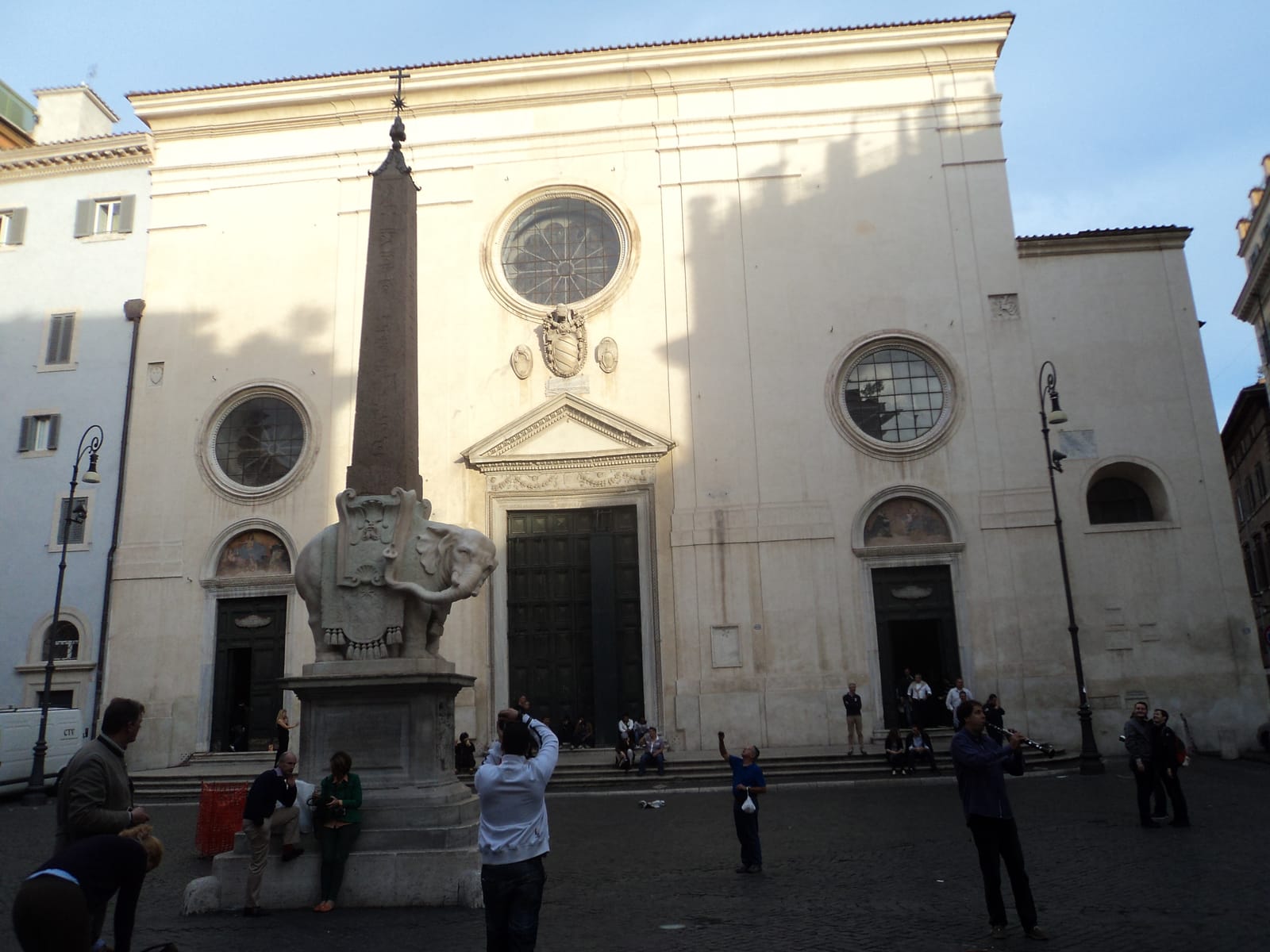
The strongest Pantheon-side church for visitors who want substance as well as convenience: Gothic bones, Dominican history, Michelangelo's Risen Christ, Filippino Lippi's Carafa Chapel, major tombs, and Bernini's elephant outside.
Start here when you want the first day to feel serious immediately. Minerva is the church that gives the central day its depth, not just its location.
Stop 2
Day 1 art payoff
San Luigi dei Francesi
A compact but essential church near Piazza Navona, especially for visitors who want one short central stop with very high artistic return.
Continue here for the strongest compact art payoff in the center. This is the church that lets the day stay concentrated without losing force.
Stop 3
Day 1 visual lift
Sant'Ignazio di Loyola
A vivid central Baroque church whose illusionistic interior makes it one of the most memorable short art-and-architecture stops near the Pantheon side of Rome.
Add this when you want the central day to end its core sequence with surprise and visual lift. It keeps Day 1 memorable without making it heavier.
Stop 4
Day 1 optional contrast
Santa Maria del Popolo
An art-rich church at the northern gateway to the center, strong for travelers interested in chapels, patronage, and the way art changes the feel of an urban threshold.
Use this only when the day genuinely benefits from a north-side art contrast. It is a good optional widening move, but not part of the core Day 1 identity.
Stop 5
Day 2 major anchor
Santa Maria Maggiore
One of Rome's essential basilicas, especially useful for travelers based near Termini who want a major church that is both historically rich and practical to reach.
Start here when the second day needs a major anchor that still belongs to an ordinary city day rather than full Vatican logistics.
Stop 6
Day 2 interpretive heart
San Clemente
The clearest single church in Rome for seeing the city in layers: a 12th-century basilica above a 4th-century church, above Roman buildings and a Mithraeum, all close enough to the Colosseum to transform an ancient-Rome day.
Use this as the interpretive heart of the day. It gives the route its layered meaning and stops the whole second day from becoming only about larger names.
Stop 7
Day 2 cathedral weight
St John Lateran
One of Rome's essential major basilicas and the clearest way to understand the city's ecclesiastical geography beyond the Vatican, with monumental scale, papal history, and a Lateran location that works best as its own focused stop.
Add this when the day still wants cathedral scale and Rome's sacred geography. Lateran raises the seriousness of Day 2, but it should sit inside a day that already has meaning, not replace it.
Stop 8
Day 3 Vatican anchor
St Peter's Basilica
Rome's most important basilica for most visitors, but strongest when treated as a planned sequence: Michelangelo's Pieta, the nave, Bernini's baldachin over the papal altar, the crossing, and the apse with the Chair of St Peter.
Start here when the final day needs Rome's largest and most ceremonial church experience. This is the stop that gives Day 3 its scale and logistical identity.
Stop 9
Day 3 optional connector
Santa Maria in Traspontina
A broad Vatican-side church that works well as a calmer interior near St Peter's, especially when you want the district to feel like more than one queue-heavy destination.
Use this only if the Vatican side still wants a church-led continuation before the route crosses into a different mood. It should never read like a required second Vatican anchor.
Stop 10
Day 3 atmospheric landing
Santa Maria in Trastevere
The essential Trastevere anchor, rewarding not just for its fame but for the way mosaics, square, and neighborhood atmosphere reinforce one another.
Finish here when you want the trip to land somewhere atmospheric, local, and recognisably different from the first two days. This is the church that lets the final day relax into neighborhood life rather than end in another heavy monument.
Choose a related route
Use one of these if you want a tighter route or a clearer next step.